Data Center Moratoriums Won't Stop Your Tokens. They Will Change the Price.
A Microsoft partner named Nebius has spent much of 2026 trying to obtain an air permit for a 400 MW gas plant it wants to run on its own site in New Jersey. The plant was the workaround. Generating its own power was how the company intended to skip the multi-year wait for a grid connection, and the plan held until a state environmental regulator had to sign off on the emissions.
That is the new constraint on American AI infrastructure at close range. On 10 August 2026, Sriram Krishnan described a collision course between agentic systems that consume more tokens as they improve, AI spreading across the economy and consuming more still, and data-center moratoriums spreading across the country. His three available answers were to make data centers welcome where they are built, to build them where they are already welcome, or to use fewer tokens for the same output.
For a company that buys tokens rather than land, the question is narrower and rarely asked. Does a county zoning board reach your invoice? It does, though not through the channel the coverage implies and not on its schedule.
What a County Can Actually Stop
A data-center moratorium is a time-boxed pause on granting new permissions, not a ban and not a cancellation: it stops approvals for a defined period or until a defined study finishes. Local government holds the real veto, and has been using it. Zoning, special-use permits and rezoning applications sit with planning commissions and county boards, and by 9 March 2026 Good Jobs First had counted 63 local moratorium actions introduced, considered or adopted, of which 54 had already passed. State legislatures moved later. At least twelve in-session states had filed moratorium bills by that date, and the drafting varies: New Hampshire's HB 1265 would halt construction for one year, Oklahoma's SB 1488 would run to 1 November 2029, and Vermont's S.205 was introduced with a moratorium through 1 July 2030.
The most quoted figure here is also the weakest. One commercial tracker reports 225 restrictions across 30 states with 151 in force as of 4 August 2026, and no second tracker with a disclosed method corroborates it. The figures that survive scrutiny are duller: the Good Jobs First bill inventory, and the Rockefeller Institute's count of 14 states considering a moratorium as of June 2026. A capacity plan should work from those.
The first statewide moratorium pauses one agency's paperwork
New York went first, and what it did is narrower than the headline it generated. Executive Order No. 62, issued on 14 July 2026, is an executive order rather than a statute. It directs the Department of Environmental Conservation to hold in abeyance applications for a discretionary permit that were pending and not yet deemed complete on the day it was signed, for data centers that "consume or can consume 50 megawatts of energy or more." Applications already found complete proceed. The order excludes facilities used primarily for manufacturing, research, education or medical care, along with the Empire AI consortium. The pause runs until the Department of Public Service delivers a final Generic Environmental Impact Statement, so it has no fixed end date.
One omission matters more than any of the carve-outs. The order reaches state environmental permitting and nothing else, which leaves local government permits and permissions untouched. Governor Hochul framed the order around utility bills, saying data-center development "threatens to hike up utility bills, deplete our natural resources, and create uncertainty for New Yorkers." Read against its own text, the first statewide moratorium is a discretionary-permit abeyance at one agency above a megawatt threshold, and a template for other states.
Federal action points in two directions at once. Senator Sanders introduced S.4214 on 25 March 2026 and Representative Ocasio-Cortez the House companion H.R.9442 on 24 June 2026, both halting construction at 20 MW and above until federal safeguards exist. Neither is law, and the mechanism is contested, because land use, zoning and retail electricity are overwhelmingly state and local powers. None of this tells you whether any capacity has actually left the map.
The Number That Isn't What It Sounds Like
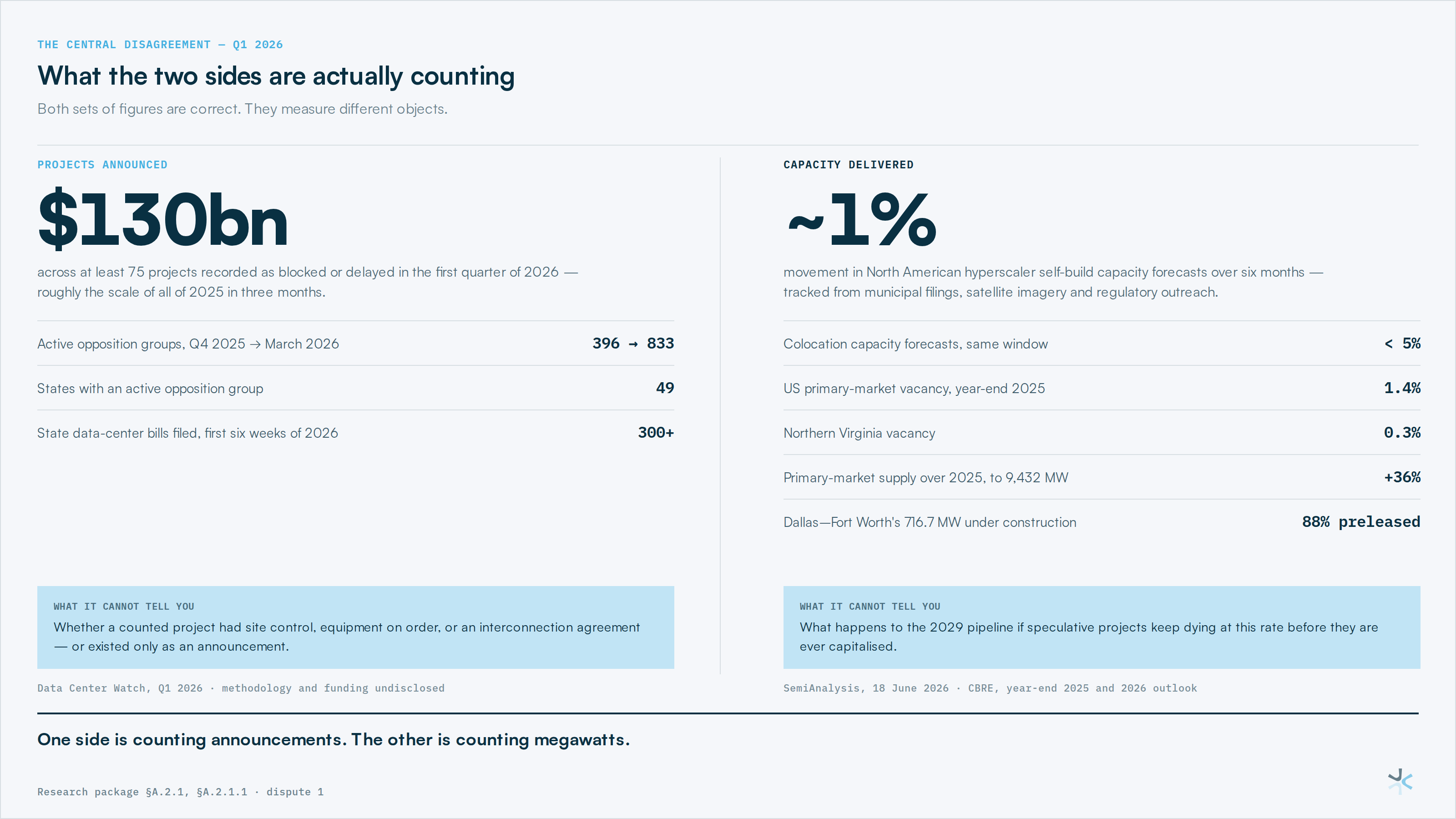
It has not, so far. The figure driving the alarm is real as a count and misleading as a conclusion. Data Center Watch recorded at least 75 projects worth roughly $130 billion blocked or delayed in the first quarter of 2026, calling it the largest single-quarter concentration on record. The same tracker put opposition groups at 833 across 49 states by March, up from 396 at the end of 2025. Writing in Forbes, Robert Szczerba called consent the bottleneck.
Capacity trackers measuring delivered megawatts see none of it. On SemiAnalysis's model, built from municipal filings, satellite imagery and direct regulatory outreach, North American hyperscaler self-build forecasts moved about 1% over six months and colocation capacity by less than 5%. CBRE's market data points the same way from an unrelated evidentiary base. Vacancy in US primary markets fell to a record-low 1.4% at year-end 2025, with Northern Virginia at 0.3%. Primary-market supply still grew 36% over 2025, to 9,432 megawatts. New capacity is spoken for before it opens: Dallas-Fort Worth's 716.7 MW under construction was 88% preleased. A market that could not build would not look like that.
What “blocked” counts, and what it doesn't
The two sides are not disagreeing about an answer. They count different objects, and the object determines the conclusion. A project passes through site control, rezoning, environmental permits, an interconnection agreement, procurement and construction before it delivers a megawatt. Opposition acts at the second and third, where announcements live. SemiAnalysis's account of the 2026 cancellations is that they were overwhelmingly early-stage speculative projects with no site control, no equipment orders and no interconnection agreement, already modeled as oversupply for 2028 and later.
The loudest version of the claim is worth tracing. A Bloomberg article of 1 April 2026 about Chinese electrical components discussed supply-chain exposure; within weeks the circulating claim was that roughly half of planned 2026 US capacity would be canceled. The honest reading of the evidence is that consent has become a genuine constraint on where projects go and how long they take, and is not yet a constraint on how many megawatts arrive. That leaves an obvious question about what is holding the schedule instead.
Twenty-Eight Months for a Transformer
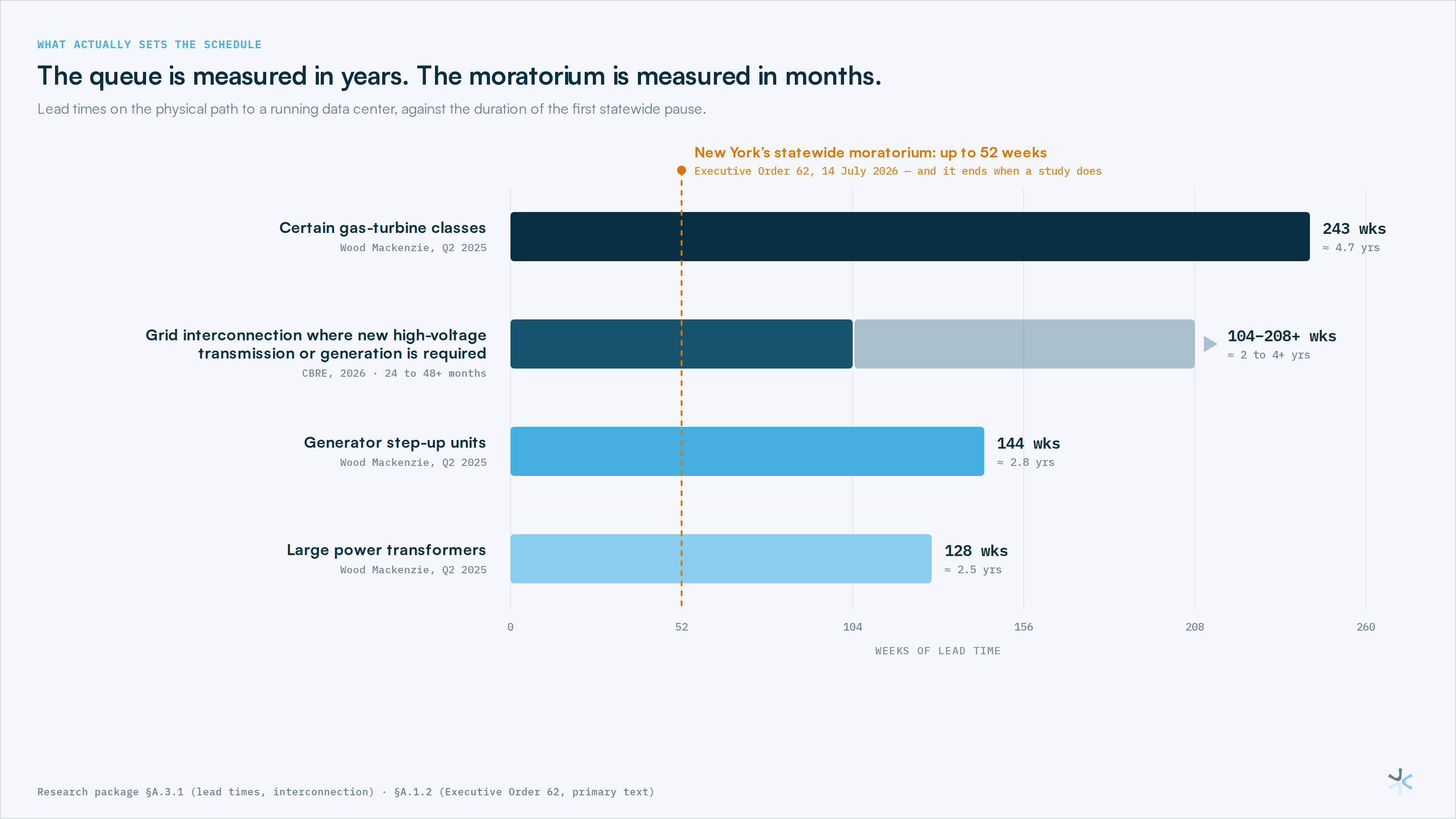
Power delivery is holding it. One analyst put the hierarchy bluntly in July 2026: what decides how fast US data centers grow is the ability to get electric power delivered to the site, and it is "not money, land, chips, or demand." The queue behind that sentence is measured in years. Where a project needs new high-voltage transmission or incremental generation, CBRE puts interconnection timelines at 24, 36 or even 48-plus months. Transmission planning is now the highest-risk variable, because a site can sit beside a substation and still fail if the surrounding network cannot absorb the new load without years of upgrades.
The equipment is no faster. Wood Mackenzie put average lead times for large power transformers at 128 weeks in the second quarter of 2025, and generator step-up units at 144. Goldman Sachs Research expects only about 60% of next year's scheduled capacity to arrive on time, falling toward 50% in the years after. Set those numbers against New York's moratorium, which runs up to a year and ends when a study does, and the ranking becomes hard to argue with.
The escape hatch lands in another queue
Behind-the-meter generation means power produced on site and delivered straight to the load, without passing through the public grid's interconnection queue. It is the industry's answer to that queue, and its numbers show how early it is. Roughly 2 GW of on-site capacity was operating across four projects by mid-2026, with 2.8 to 3.2 GW expected by year end. Announced on-site gas generation stands at about 101 GW. The gap between announced and running is this subject in one comparison. Turbines are their own bottleneck, with certain classes quoted at 243-week lead times.
Which returns to Nebius and its air permit. Moving generation behind the fence converts a grid-interconnection problem into an emissions-permitting problem, and regulators answering to the same electorate decide both. Equipment can be ordered earlier and sites moved. Permission is the one input with no procurement path, and it will keep mattering because the opinion behind it is not softening.
Why the Opposition Doesn't Recede
Four separately fielded surveys between March and May 2026 agree within a narrow band. Gallup, fielding from 2 to 18 March 2026 among 1,000 adults with a four-point margin of error, found 71% opposed to construction of AI data centers in their local area, with 48% strongly opposed. Quinnipiac put opposition at 65% in April, and Emerson College measured 63% alongside a rise of 21 points since December 2025. Embold Research, polling 4,118 registered voters for Heatmap News from 15 to 28 May 2026, put opposition to a data center near the respondent's home at 71%.
The Gallup comparison survives the obvious caveat about proximity questions. Asked on deliberately parallel wording, Americans oppose a local nuclear plant at 53%, eighteen points below their opposition to a data center, against a nuclear-opposition peak of 63% since 2001. Strong opposition runs across parties: 56% of Democrats, 48% of independents, 39% of Republicans.
There is a mechanism underneath the numbers, and it is billing. Across PJM's last four base capacity auctions, its independent market monitor puts data-center-driven charges at $29.4 billion, 46% of $63.6 billion in total capacity charges. In the most recent auction alone it was $6.3 billion, 38% of $16.4 billion, and an earlier reading put $6.2 billion of that against data centers not yet built. Capacity prices reached $329.17 per megawatt-day for 2026/27 and $333.44 for 2027/28. Opposition at that level does not revert on a news cycle while a monthly bill keeps feeding it.
The Bill Arrives as a Price, Not a Shortage
Watch what legislatures pass rather than file, and the endgame looks less like prohibition than a tariff. New Jersey's legislature approved a three-bill package at the start of July 2026 and Governor Sherrill signed the accompanying energy legislation on 7 July. The data-center measure among them, the Data Center Fair Share bill (S731/A796), creates a new ratepayer class and rate structure for data centers so that they pay for their own energy use and the associated grid infrastructure. It also makes them cut back before residential ratepayers are affected when the grid is strained.
Virginia took the other available route and priced the consumption directly. Its budget sets a statewide electricity consumption tax on data centers at $0.011 per kilowatt-hour from 1 July 2026 to 1 July 2028, expected to raise around $1.2 billion across the two years. New York's order fits the same pattern, commissioning a Community Investment Framework within 60 days, an interconnection working group within 90 days and a water assessment within twelve months. These are standards-and-cost instruments wearing the language of a pause.
The argument about whether that is wise remains open. The Cato Institute argues that moratoriums fail to solve the resource concerns motivating them while delaying development that would help. The American Council of Engineering Companies, whose members build these facilities, warns that the risk is pauses becoming a substitute for planning rather than a bridge to it. Both parties have an interest, and the disagreement is about values, not measurement. What follows is the same either way: the cost of a megawatt is rising, and somebody pays it.
Which Layer Are You Buying At?
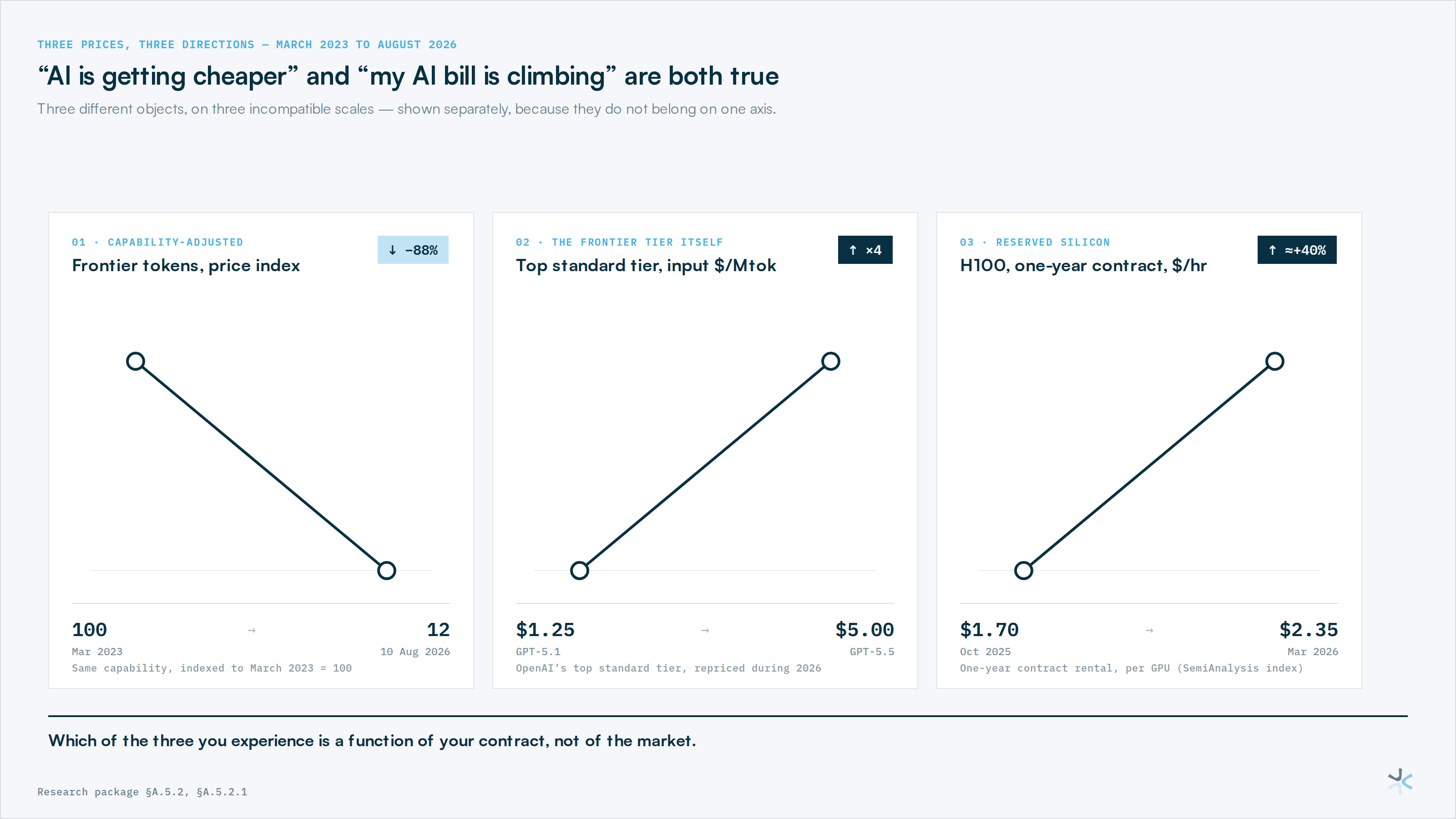
Here is where a county board reaches an invoice, by a route most operators do not watch. Three prices moved in three directions between March 2023 and August 2026, and which one a firm experiences is a function of its contract rather than of the market. The frontier token price index, which measures what a fixed level of capability costs, stood at 12 on 10 August 2026 against a base of 100 in March 2023. Capability got 88% cheaper.
The frontier itself did not. OpenAI's top standard tier repriced upward during 2026, from GPT-5.1 at $1.25 and $10.00 per million input and output tokens to GPT-5.5 at $5.00 and $30.00, a fourfold rise. Reserved silicon moved in the same direction. One-year contract rental for an H100 sat at $1.70 an hour in October 2025, broke above $2.00 in late January 2026 and reached $2.35 by March, about 40% in five months. By March, H100, H200 and B200 rental capacity had become close to impossible to find at any term.
Your volume is growing faster than your unit price is falling
A falling unit price only helps if volume holds, and it is not holding. Gartner puts agentic workloads at 5 to 30 times the tokens per task of a standard chatbot request, a figure that travels with Gartner's name attached because no independent measurement exists. What is measured is directional and consistent with it. The largest empirical study of real usage, covering more than 100 trillion tokens through 30 November 2025, found average sequence length had more than tripled in twenty months to over 5,400 tokens, and reasoning-optimized models had reached half of all tokens processed. OpenRouter's chief operating officer says agents have now passed humans in token consumption, a claim from an interested party, and a plausible one.
No source establishes how many mid-market firms hold reserved capacity against how many buy tokens at list, so the distribution of this exposure is unknown. The structure of it is not. A firm pinned to the frontier tier, with agentic volume growing, can watch its bill climb through a period in which every headline about cheaper AI is also true.
The Only Answer You Own
Of the three answers Krishnan named, two belong to somebody else. Making data centers welcome is a hyperscaler and legislature problem, and building where they are welcome is a siting decision taken above almost every buyer. Efficiency executes on your own timetable, without anyone's approval, and the mechanisms with the firmest evidence are unglamorous.
**Caching.** Anthropic discounts cached input by roughly 90% and OpenAI by about half. The part that matters under scarcity is that for most Claude models only uncached input counts toward the input-tokens-per-minute limit, so prompt design buys throughput that tier progression otherwise gates.
**Routing.** RouteLLM, an open published framework, reports holding roughly 95% of frontier-model quality while sending only 14% to 26% of calls to the strong model, which lands as a 75% to 85% cost reduction on routed traffic.
**Distillation.** Moving a workload from a 70-billion-parameter model to a distilled 8-billion or 14-billion variant cuts GPU requirements by a factor of four to eight where the task tolerates it.
**Governance.** Anthropic publishes a monthly spend cap per usage tier alongside the rate limits, $500 at Start rising to $200,000 at Scale. A budget an operator can enforce is worth more than one it can only forecast.
Vendors and consultancies report that teams applying the full stack reach 60% to 80% reductions in token spend. Those aggregates come from parties selling the work. The published discounts and the RouteLLM results can be checked, and they justify the engineering on their own.
What Follows
The permission layer is real and durable. It governs where American compute lands and how long it takes to arrive. It does not govern whether a mid-market firm can buy tokens, and writing as though it does misreads every delivered-capacity measurement available. The wave is producing a price instead: a New Jersey ratepayer class, a Virginia tax at $0.011 per kilowatt-hour, a New York framework for community investment, and a long line of states drafting their own.
Two things follow, and neither is a procurement panic. Establish which of the three prices your contracts expose you to: a firm buying frontier tokens at list, a firm holding reserved silicon and a firm on commodity inference sit in three different positions while usually believing they sit in one. Then build the efficiency lever now, while it is still a margin decision rather than a forced one.
Questions this article answers
**Do data center moratoriums reduce AI compute capacity?**
Not measurably, so far. SemiAnalysis's tracking put six-month movement in North American hyperscaler self-build forecasts at about 1% and colocation at under 5%, while CBRE recorded record-low 1.4% vacancy at year-end 2025 and 36% growth in US primary-market supply over the year. The wave changes where capacity lands and how long it takes, not how much arrives.
**What did New York's data center moratorium actually do?**
Executive Order No. 62, issued 14 July 2026, directs the Department of Environmental Conservation to hold in abeyance discretionary permit applications not yet deemed complete, for data centers that consume or can consume 50 megawatts or more. Local permits are unaffected, and manufacturing, research, education and medical facilities are excluded.
**What is actually constraining US data center growth in 2026?**
Power delivery. Interconnection runs 24 to 48-plus months where new high-voltage transmission is required, large power transformers averaged 128-week lead times in the second quarter of 2025, and generator step-up units 144 weeks. Goldman Sachs Research expects about 60% of next year's scheduled capacity to arrive on time.
**Is AI inference getting cheaper or more expensive in 2026?**
Both, depending on what a firm buys. The frontier token price index stood at 12 on 10 August 2026 against a base of 100 in March 2023, while OpenAI's top standard tier repriced from $1.25 to $5.00 per million input tokens and the H100 one-year contract rose from $1.70 an hour in October 2025 to $2.35 by March 2026.
**How can a company reduce AI token costs without cutting usage?**
Caching, routing and distillation. Anthropic discounts cached input by roughly 90%, and for most Claude models only uncached input counts toward the input-tokens-per-minute limit, so caching buys throughput as well as price. RouteLLM reports holding about 95% of frontier quality while sending 14% to 26% of calls to the strong model.