The Death of the Single Deliverable: Why Fractional Firms Are Becoming Managed-Service Operators
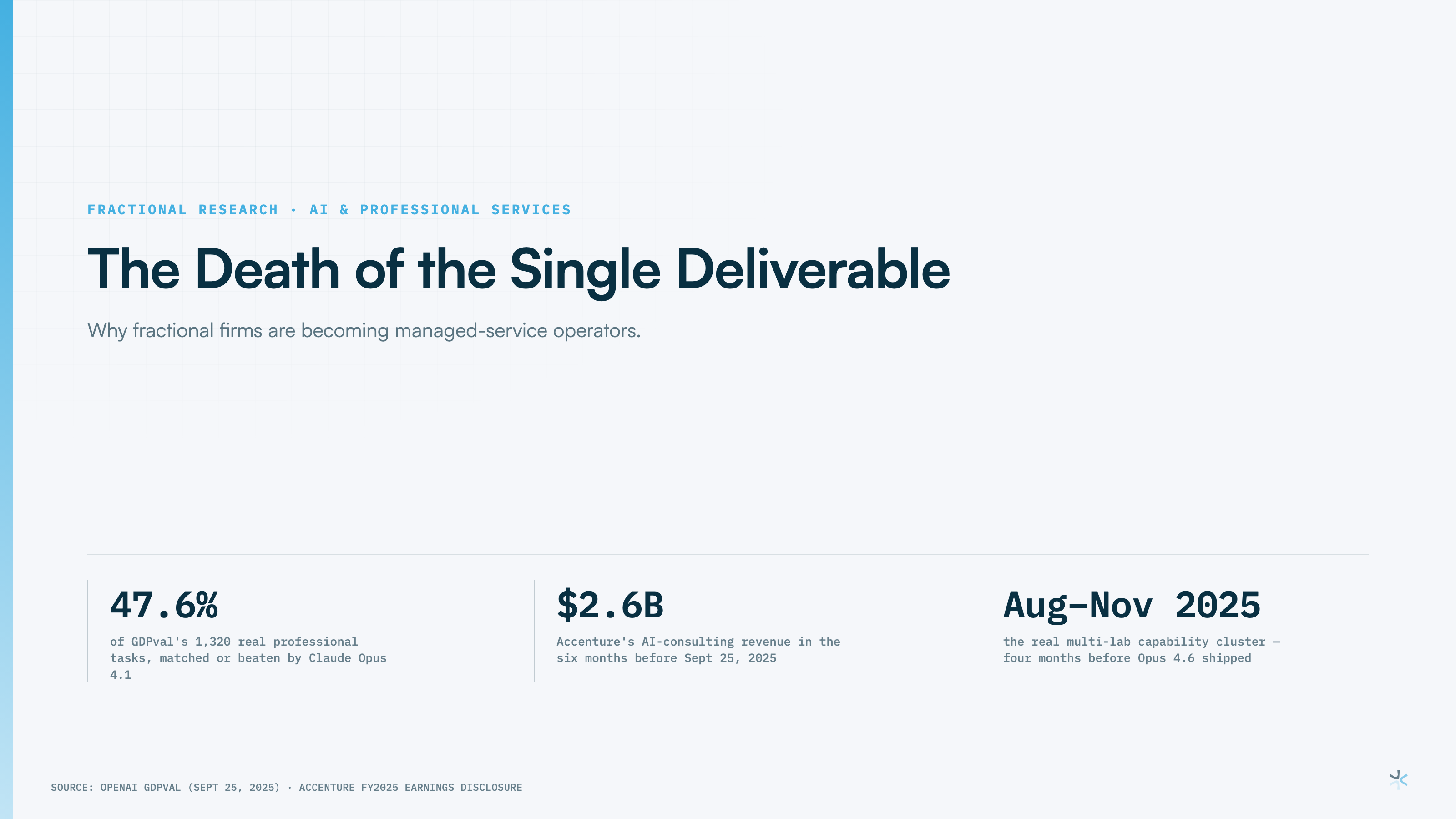
On September 25, 2025, Accenture's chief executive Julie Sweet told analysts on an earnings call that the company was "reinventing what we sell, how we deliver, how we partner, and how we operate Accenture." By the end of that fiscal year Accenture had eliminated roughly 22,000 jobs and taken an $865 million restructuring charge, even as it booked $2.6 billion in AI-related consulting revenue over the preceding six months. The world's largest professional-services firm was not shrinking. It was rebuilding around a different unit of sale: not hours, and not even discrete deliverables, but outcomes it owns end to end.
That is the same move a lean, boutique fractional operator now has to make, for a smaller but structurally identical reason. Once a client can direct a frontier AI model to produce a passable financial model, brand deck, or standard operating procedure on its own, a firm still pricing per deliverable competes against a substitute that costs the client almost nothing. The deliverable stops being the product. The surviving model sells the whole pipeline: the fundraise and the back office, the brand system and the go-to-market plan, priced and staffed as one ongoing scope. Reaching that conclusion honestly means starting with a claim about AI capability that is wrong as stated, and correcting it before building on top of it.
What Actually Changed in AI Capability by Late 2025 — and What Didn't
The founder's own account of when this became possible names a specific trigger: Claude Opus 4.6, arriving in October 2025. The claim is directionally right and factually wrong, and the correction matters enough to state plainly.
A Model by the Wrong Date
Claude Opus 4.6 is real. Anthropic introduced it as a frontier model built for coordinated "agent teams" and enterprise coding workflows, and Microsoft made it available on Azure the same window. But it shipped in February 2026, per Anthropic's own system card and TechCrunch's coverage of the release, four months after the founder's claimed turning point. No Anthropic model shipped in October 2025 at all; the nearest release is the tail end of Claude Sonnet 4.5, launched two days earlier, on September 29. Opus 4.6 did not cause a shift the founder experienced in October 2025, because it did not yet exist.
What did happen, and what the founder is more plausibly recalling, is a genuine cluster of frontier releases spanning three labs across August through November 2025. OpenAI shipped GPT-5 on August 7. Anthropic followed with Claude Sonnet 4.5 on September 29, a model Anthropic says can sustain autonomous coding work for 30 hours or more. Google released Gemini 3 on November 18, posting a Humanity's Last Exam score of 37.4 against a prior best of 31.64. Anthropic answered six days later with Claude Opus 4.5, scoring 80.9% on SWE-bench Verified against Gemini 3 Pro's roughly 75% and GPT-5.1-Codex-Max's 77.9%. METR's autonomous task-completion metric tells the same story from a different angle: the doubling time compressed from roughly seven months to roughly four months across the 2024–2025 window. See Figure 1.
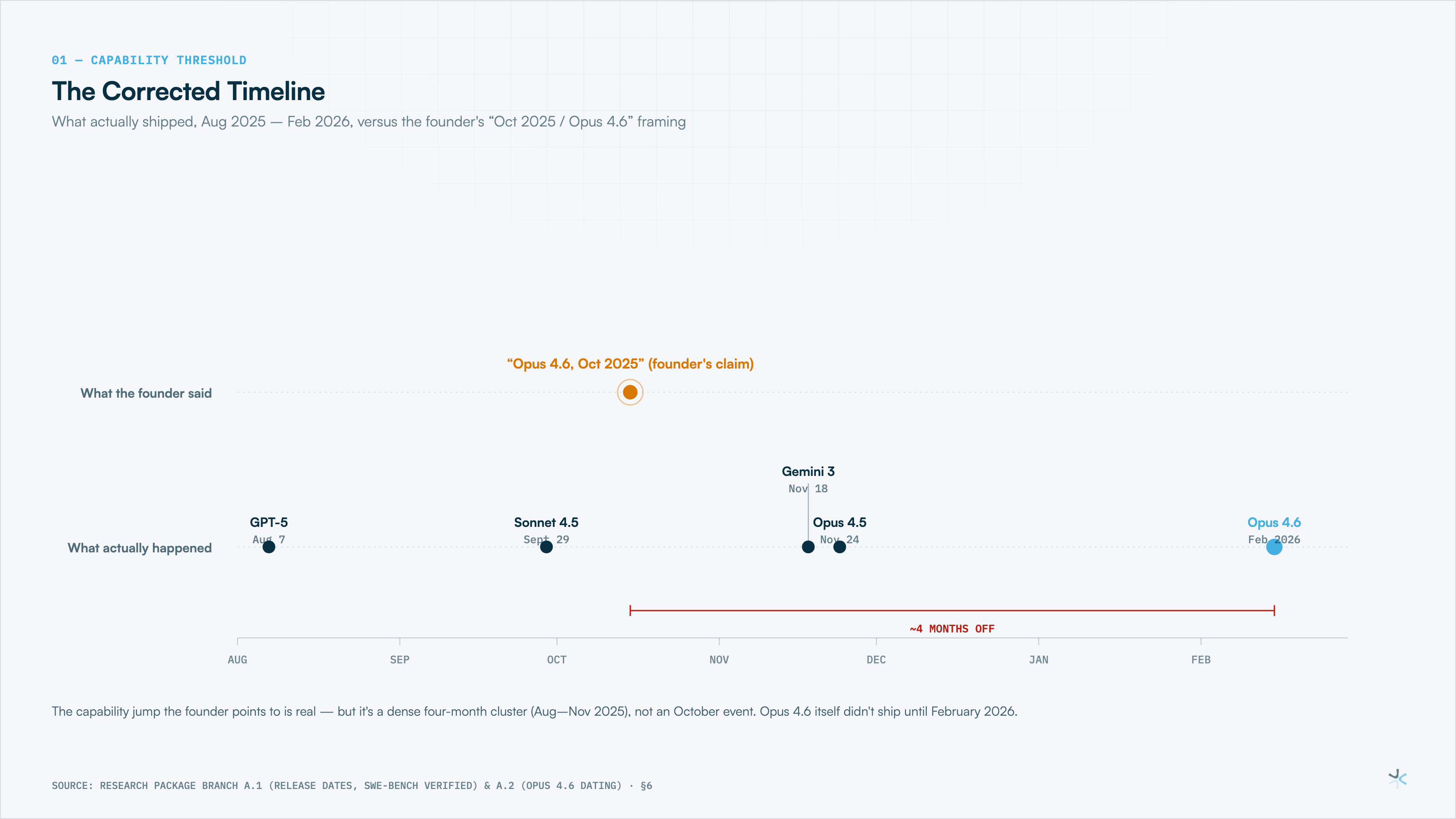
Whether that compressed wave counts as a discrete threshold or an unusually dense stretch of a longer exponential curve is a live dispute in the capability-research literature itself, and this article will not lean on "threshold" language it cannot fully defend. What is not in dispute is the direction and the rough dating: something real changed in the second half of 2025, several months before, not because of, a model called Opus 4.6.
A real capability jump is one thing. Whether it is good enough to replace what a client pays a specialist for is another question, and it is where the more defensible version of the founder's argument actually rests.
Why "Good Enough" Beats "Best" — What GDPval Actually Shows
OpenAI's GDPval, published September 25, 2025, is the closest available primary evidence for that question. Rather than testing whether a model can answer hard questions, GDPval grades whether a model's finished output matches a working professional's, across 1,320 real tasks spanning 44 occupations in nine industries, each representing more than 5% of US GDP. Graded against industry-expert professionals, the best-tested model, Claude Opus 4.1, matched or beat human experts on 47.6% of the graded task set, roughly 100 times faster and 100 times cheaper. GPT-5 matched or beat experts on 39.0% of the same tasks; GPT-4o managed 12.5%. See Figure 2.
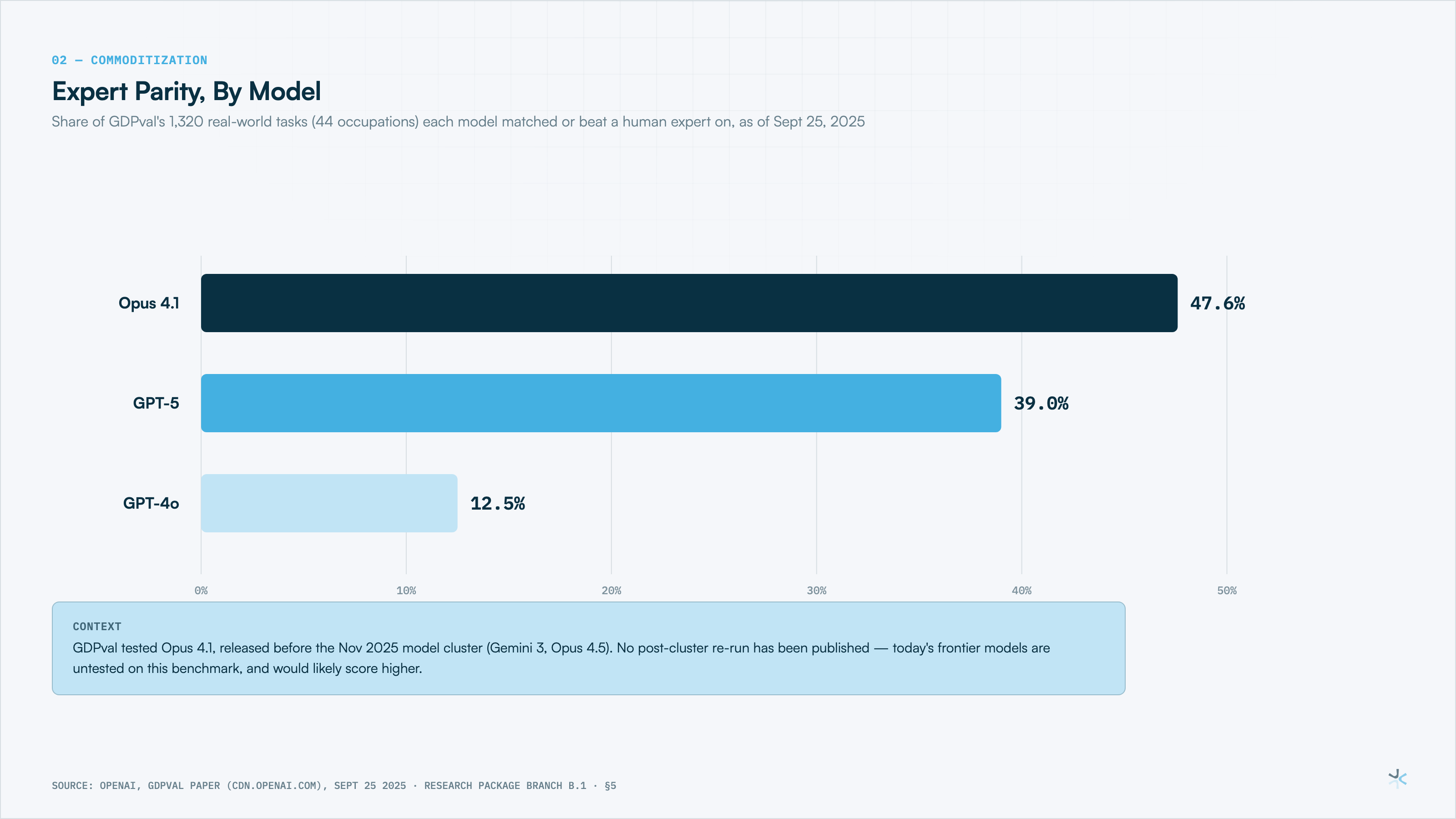
Opus 4.1 predates the capability cluster described above, and no independent lab has run a GDPval-style test using Opus 4.5 or Gemini 3, so today's frontier models likely clear an even higher bar than 47.6%, untested.
The Format Gap
The number that matters more than 47.6% is what happens on the other side of it. GDPval's own results, and third-party coverage tracking them, show performance dropping sharply on tasks delivered in native, messy formats: a live Excel financial model with working formulas, a styled PowerPoint deck, rather than plain text. That gap sits precisely on top of what a fractional CFO, brand consultant, or operations lead sells for a living. A model that matches an expert on a well-defined text task and stumbles on the same task rendered as a real deliverable is not yet a full substitute for the person who builds it. It is close enough, on enough of the work, to make single-deliverable pricing no longer defensible on its own.
Is This Actually Happening — or Just Newly Possible?
Capability is not the same as behavior change. Industry commentary describes clients pulling spend directly because of AI: one widely repeated figure holds that 60% of senior marketing leaders cut agency spend in 2025 for that reason, alongside a claim that global ad spending grew 8.6% that year while agency holding-company revenue fell 1.2%. Both figures circulate across marketing-trade contributor pieces without a traceable, named survey behind either one. The design-freelance evidence points a different way: several sources describe freelancers absorbing AI tools to take on more volume rather than being displaced outright, with no clean data showing net contraction attributable to AI.
This is the honest gap in the case. The capability exists, per GDPval. Whether clients are actually substituting it for hired specialists, at scale, is asserted more often than measured, and no primary survey settling the question turned up in this research. What can be shown instead is not aggregate behavior but a close-up account of one operator's business changing shape in real time.
What Selling the Whole Pipeline Actually Looks Like
Four engagements closed within roughly the same eighteen-month window illustrate what the shift from deliverable to pipeline looks like in practice, though none is offered as evidence of a broader market pattern. They are first-person, unnamed-client cases with no public record to corroborate them, and none should be read as more than what one operator experienced.
A psychologist building a public practice hired the same firm for a YouTube channel, a book launch, and the back-office operations to run both, rather than a video editor, a ghostwriter, and a bookkeeper separately. A finance client outsourced fundraising, due-diligence preparation, payroll, and bookkeeping as one managed function rather than four vendor relationships. A solo digital-transformation consultant retained the firm for brand identity, go-to-market strategy, and ongoing client servicing together, replacing a logo project followed by a separate marketing engagement. A law firm brought in a four-function transformation spanning finance, digital presence, operations, and branding within a single retained scope. A fifth engagement, a fractional operations role inside an India-based semiconductor company, extended the same logic in-house. See Figure 3.
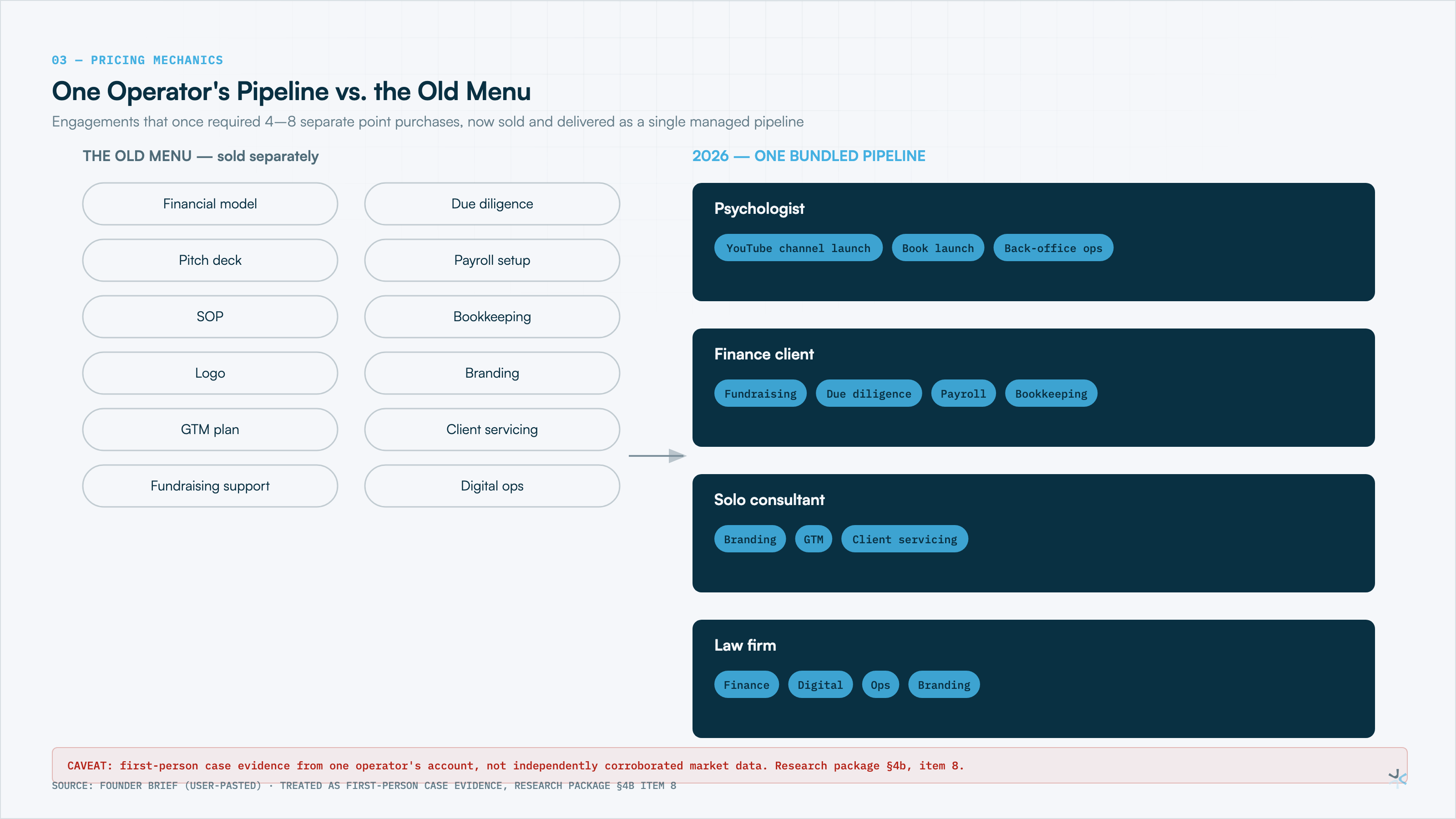
What connects the engagements is not that AI performed the work. It is that the client no longer needed to buy the pieces separately, because a firm willing to own the whole outcome could do so more efficiently than a client assembling four vendors on its own. That is the mechanism the capability data above predicts and the behavioral data above cannot yet prove at scale. One operator's engagements are a demonstration, not a census.
The Broader Market Is Moving the Same Way — Even Where the Statistics Don't Hold Up
Whether that pattern extends beyond one firm is harder to establish than the marketing material around fractional-executive services suggests. Multiple advisory-content sites cite a global fractional-executive market growing from $5.7 billion in 2024 to $19.1 billion by 2033; a different search pass turns up $9.4 billion growing to $24.7 billion by 2034. Both figures, and a widely repeated claim attributed to Gartner that 30% of midsize enterprises will employ at least one fractional executive by 2027, recur nearly word for word across at least four differently branded sites, with no locatable primary report behind any of them. The same figures, recycled across sources that all trace to nothing, are a finding in their own right: the direction is plausible; the numbers are not usable as fact.
Accenture's restructuring is a stronger data point precisely because it is one company's real disclosure, not an industry survey. Sweet's "reinventing what we sell" framing is her own characterization of Accenture's strategy, not a neutral fact about the market, but the $2.6 billion in AI consulting revenue and the 22,000 job eliminations behind it are verified. Accenture also said it expects operating margins to grow at a "historic" annual rate from the shift, not shrink, a detail this article returns to in the section on margins.
A third, frequently cited figure deserves naming rather than quiet avoidance: the claim that 73% of consulting clients now prefer outcome-based pricing recurs across at least four content sites, attached inconsistently to different years and quarters, with no named survey behind it anywhere in this research. It is the most quotable number available for this argument, and also the one this article will not use, because it cannot be traced to anything real.
The Billing Model Is the Last Domino — and It's Falling More Slowly Than the Founder's Own Experience Suggests
Single-deliverable pricing is a scope problem: what a firm agrees to sell. Hourly billing is a different, related problem: how a firm measures what it sells. The two are often collapsed into one complaint, and the evidence on the second is less clean.
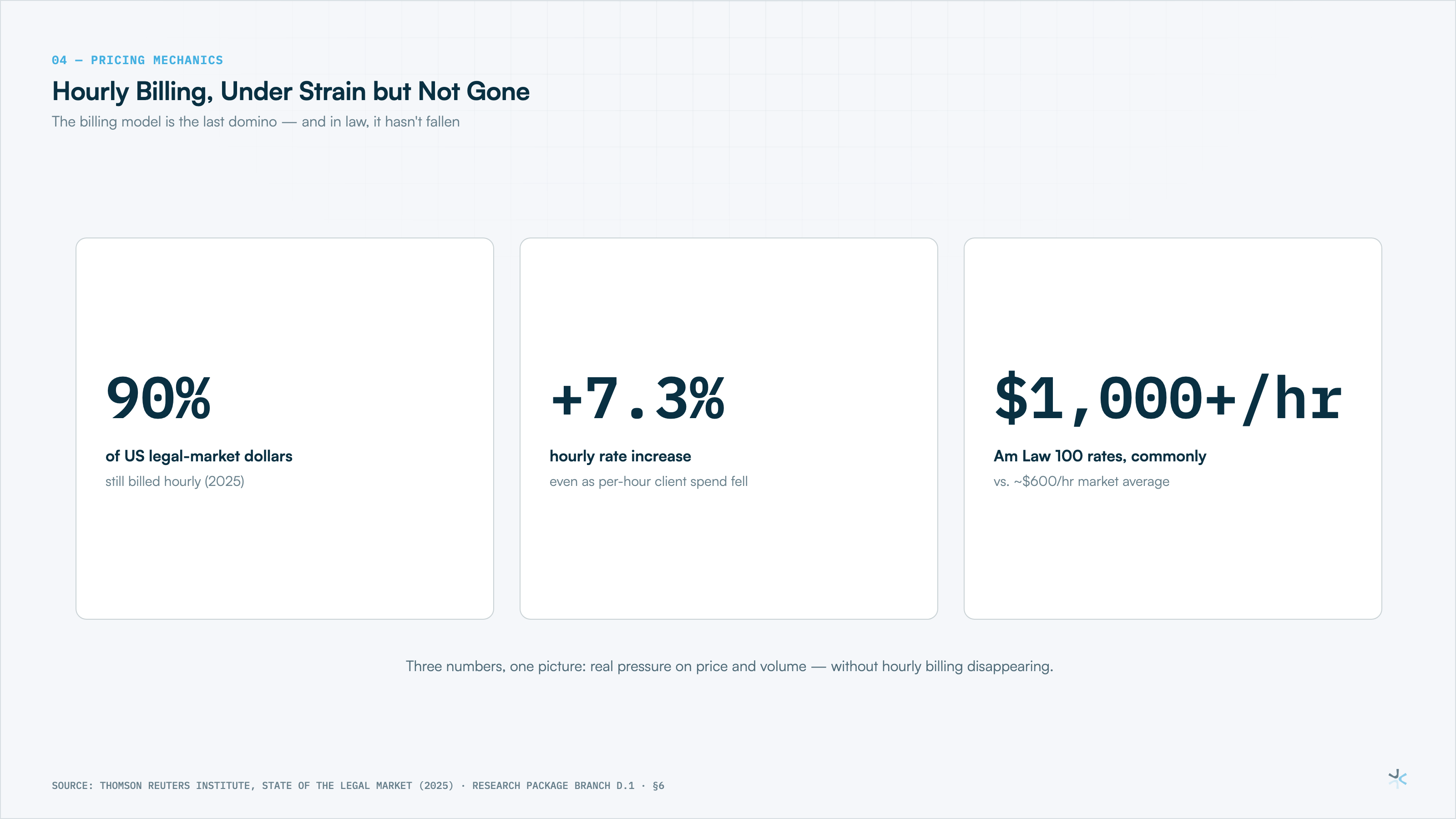
In law, the vertical with the best available primary data, hourly billing remains structurally dominant. Thomson Reuters Institute's survey work finds that 90% of US legal-market dollars were still billed hourly as of 2025, even as firms raised nominal rates 7.3% while clients' actual per-hour spend fell: a volume-and-scope story, not a pricing-revolt story. Am Law 100 rates now regularly exceed $1,000 an hour against a roughly $600 market average, pushing clients toward mid-size firms. Ethics rules in most US jurisdictions require lawyers to record actual time regardless of how quickly AI lets them finish, a structural brake, not merely a cultural one.
Marketing-trade commentary describes hourly and retainer billing as headed for extinction among sophisticated firms. Legal-market data describes it as durable, for reasons that have nothing to do with whether AI makes the work faster. Both positions are real; the disagreement is genuinely unresolved rather than one side simply being wrong. What the legal data does settle is that "hourly billing doesn't work" overstates a domain-dependent shift as a universal one. Thomson Reuters frames the standoff directly: both sides are waiting for the other to blink first. See Figure 4.
The more defensible version of the founder's claim was never really about the hour as a unit of measure. It is about scope: refusing to sell four separate line items when one owned outcome serves the client better. That argument does not require hourly billing to disappear to be true.
The Margin Trap — Why Working More Doesn't Feel Like Winning
The founder's most personally felt complaint is that quality has gone up, fees have stayed flat, and margins are being eaten even as the firm works harder, not less. The evidence supports a narrower version of that claim than a universal one.
Professional-services EBITDA margins, per Deltek and Harvest's vendor-run trend reporting, fell from 16.1% in 2022 to 9.8% in 2024, alongside a rise in GenAI project usage from 19.3% to 27.1% of projects and roughly 240 hours and $19,000 in notional annual savings per professional that never converted into firm-level profit. That data comes from a vendor selling into this market and skewing toward smaller firms; it is directionally credible, not independently audited.
Accenture, already on the page from the previous section, is the clearest counter-example. The same AI shift that compresses margins at boutique and mid-market firms is producing margin expansion at scale for the largest integrator in the industry, because Accenture is capturing pricing power a smaller firm has not yet built. See Figure 5.
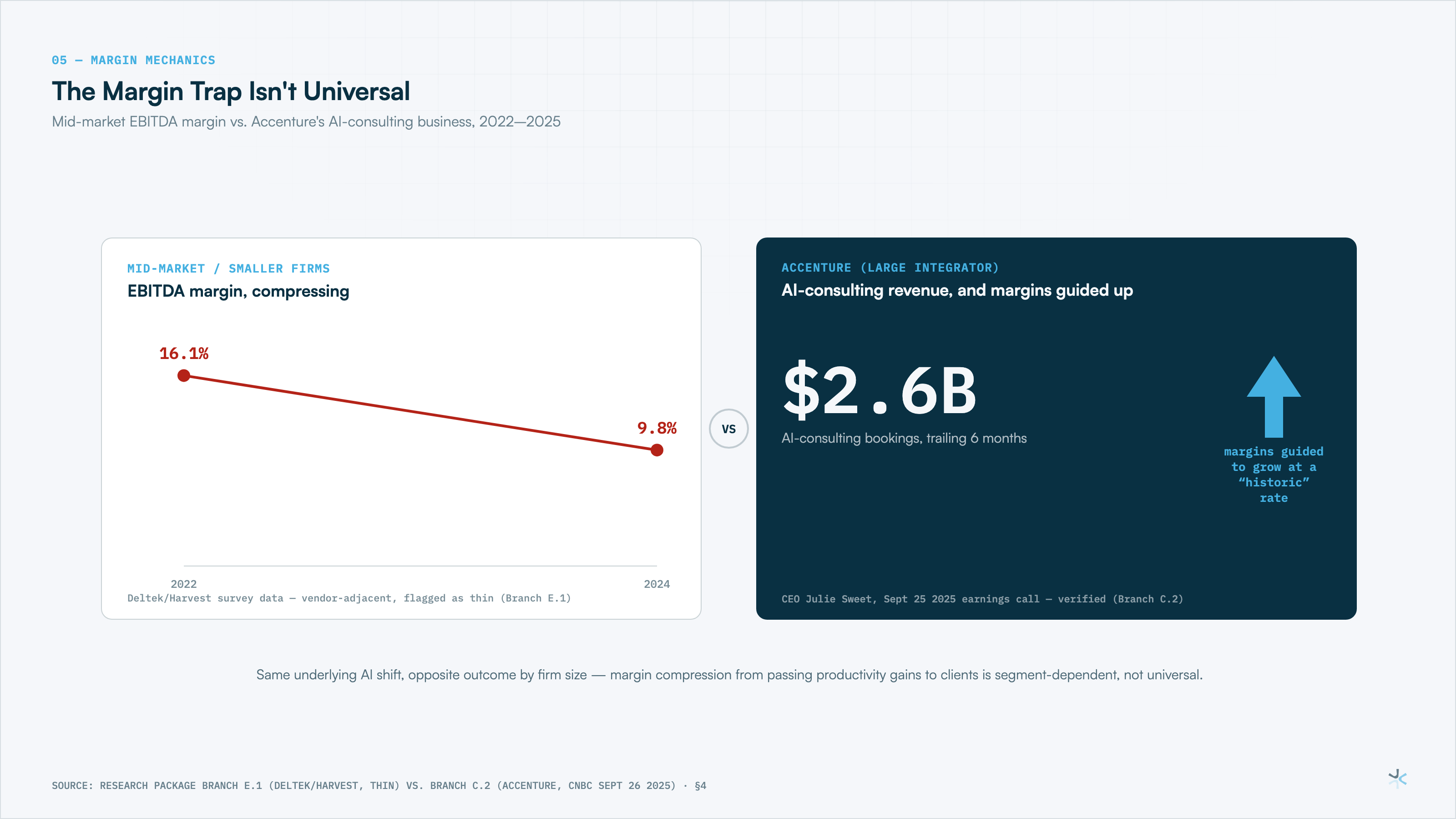
That split is not a contradiction to explain away. It is the finding: margin compression from passing AI-driven productivity gains through to clients looks like a lean, mid-market, or boutique-firm phenomenon, not a universal law, because scale buys pricing power boutique firms have to earn engagement by engagement. For a firm the founder's size, that pressure is exactly what makes selling the whole pipeline, rather than pricing per hour saved, the route to margin available to the smaller player.
The Case Against the Case — and Why It Still Points the Same Way
The strongest available objection to all of this comes from MIT Media Lab's NANDA initiative, whose "State of AI in Business 2025" study reviewed more than 300 public enterprise AI initiatives and $30 to $40 billion in investment, and found that roughly 95% showed no measurable profit-and-loss return as of August 2025.
Read at face value, that finding threatens the whole argument: if most enterprise AI deployments fail to pay for themselves, why would clients trust AI-driven managed services? MarketingAIInstitute's direct rereading of the same study supplies the answer the headline number obscures. The failure MIT documented is overwhelmingly organizational, a "learning gap" in how enterprises integrate a new tool, not a failure of the models to produce usable output. Tools built by external vendors, per the same study, succeeded roughly twice as often as tools built internally.
That distinction is the line between a company building AI adoption in-house and one hiring an external operator who has already built the workflow and the integration around the tool: the founder's actual business model, not an adjacent one. Read closely rather than headline-deep, the strongest counter-argument in this research supports a narrower, more defensible version of the thesis: managed AI, run by an outside operator who owns the whole outcome, succeeds where improvised internal adoption mostly does not.
Conclusion: Sell the Pipeline, Not the Deliverable
The core claim holds, corrected. AI capability crossed a real, well-documented threshold, not in October 2025 and not because of a model called Opus 4.6, but across a compressed, multi-lab release cluster running from August through November 2025. That capability closes enough of the gap on single, well-defined deliverables that pricing per deliverable is no longer defensible on its own; GDPval shows models matching human experts on nearly half of a real, graded task set, with the remaining gap concentrated in the messy, native-format work services firms actually sell. What cannot yet be shown, honestly, is that clients are substituting AI for hired specialists at scale; the behavioral evidence is thin and attributed, and should be treated that way. The resulting margin pressure is not universal either. It falls hardest on lean, mid-market, and boutique operators who have not built Accenture's pricing power, the segment the founder's own business sits inside.
None of that weakens the case for selling the whole pipeline instead of the single deliverable. It sharpens it. A firm without Accenture's scale cannot compete on price per hour saved, and cannot compete on price per deliverable against a client's own AI tools either. What it can still sell is what neither a client's chatbot nor a mid-size competitor easily replicates: an outside operator who owns the outcome end to end, integrates the tool correctly, and is judged on results rather than line items. That is a narrower claim than the idea that AI is changing everything. It is also, on the evidence gathered here, defensible.