India's Compute Decade: What the 2047 Horizon Is Building

Introduction
On 1 February 2026, India's Union Budget proposed exempting foreign companies from Indian tax on the income they earn serving global cloud customers through data centers located in India, with the exemption running to the tax year ending 31 March 2047. The Budget set that horizon inside the government's stated ambition of a developed India by 2047, and Ashwini Vaishnaw, the Union Minister for Electronics and Information Technology, told reporters the measure would bring in investment up to $200 billion.
On 17 August 2026, the President of India gave assent to an Act that deleted the approval machinery that same exemption had been built on. An ordinance had already made the correction on 5 June, roughly ten weeks earlier, because the machinery was not working: more than four months after the exemption came into force on 1 April 2026, the Central Government had notified no qualifying data center and no qualifying foreign company, so nobody was yet eligible to claim it.
Those two dates describe a state that is doing something more interesting than announcing a tax break. What India is assembling around that exemption now shapes which jurisdiction a workload runs in, what a multi-year committed-spend price is worth by its third year, and whether a twenty-one-year statutory horizon means anything against a grid that still has to be built.
What India Changed in Its Own Tax Law
To see why a government would legislate away its own revenue claim, start with the claim. A permanent establishment is the threshold of presence at which a foreign business becomes taxable in a country other than its own. India's tax treaties follow the model convention published by the OECD, the intergovernmental body whose text most of the world's tax treaties are built from, and under that model a server sitting in India can cross the threshold when it is at the enterprise's disposal and used for core business rather than for preparatory or auxiliary work.
Indian decisions pushed that threshold past the question of who owned the hardware. In 2007, the Income Tax Appellate Tribunal held in *Galileo International* that computer terminals installed in Indian travel agents' premises created a fixed-place permanent establishment for the foreign company that had supplied and controlled them remotely, a finding the Delhi High Court later confirmed. The Authority for Advance Rulings, the body that issues binding advance tax opinions to non-residents, went further in 2018, holding in *MasterCard Asia Pacific* that ownership of the equipment was immaterial where the foreign enterprise had functional control and used the infrastructure in its core revenue-generating operations in India.
The exposure those decisions created was never tax on Indian sales, which India taxes anyway. It was the risk that a share of a company's worldwide cloud revenue could be pulled into an Indian profit-attribution dispute because some of the processing behind that revenue happened to touch Indian racks. *International Tax Review* put the position as infrastructure being offshore while the tax risk was onshore, and for a hyperscaler, meaning one of the handful of cloud providers that build at gigawatt scale, an unquantified claim on global income is a materially worse problem than a known rate on local income.
What the Finance Act 2026 does about that is narrow and specific. It inserts Entry 13C into Schedule IV of the Income-tax Act 2025, which lifts a defined class of income out of India's tax base rather than amending the charging provisions that create the liability in the first place. Ministry sources described the effect as ensuring that the global income of overseas cloud companies will not be taxed in India merely because they procure data center services from within the country. The exemption runs 21 tax years, from 2026-27 through 2046-47, a span reported variously as 20 years and, in *Forbes India*'s headline, as 30 years. A state does not usually give up a claim on that horizon unless it has decided the claim was costing it more than it collected.
The Stack Behind the Headline
The exemption reads as a standalone giveaway only if it is read alone, and the Budget that carried it moved on four other layers in the same breath, two by outlay and two by rule. Beneath the digital-infrastructure layer sits silicon: the Budget announced India Semiconductor Mission 2.0, with a provision of ₹1,000 crore for FY2026-27 aimed at manufacturing equipment and materials, full-stack Indian intellectual property, and the talent pipeline behind both.
Beneath silicon sits components, and that layer is the one already producing numbers rather than intentions. The Electronics Components Manufacturing Scheme launched in April 2025 with an outlay of ₹22,919 crore, drew investment commitments at roughly double its target, and had its outlay raised to ₹40,000 crore in the Budget. Its third tranche, cleared on 2 January 2026, approved 22 proposals carrying ₹41,863 crore of projected investment across eight states, against which the ministry projects ₹2,58,000 crore of production and about 34,000 direct jobs. That is the difference between a scheme that has been announced and one that is being drawn on.
The layer with the least coverage may be the most consequential for firms already operating in India. Under the Income-tax Rules 2026, four separate transfer-pricing categories for IT services, carrying margins between 17% and 24%, were consolidated into a single category at 15.5%, and the threshold for electing that safe harbour rose from ₹300 crore to ₹2,000 crore. A related change gives Indian data center companies serving a foreign group entity a 15% cost-plus markup. Both took effect on 1 April 2026, elected on Form 49 across a five-year block, and India's advance pricing agreement program reached 1,034 cumulative agreements by FY2025-26 with IT-specific unilateral agreements now targeted for completion within two years.
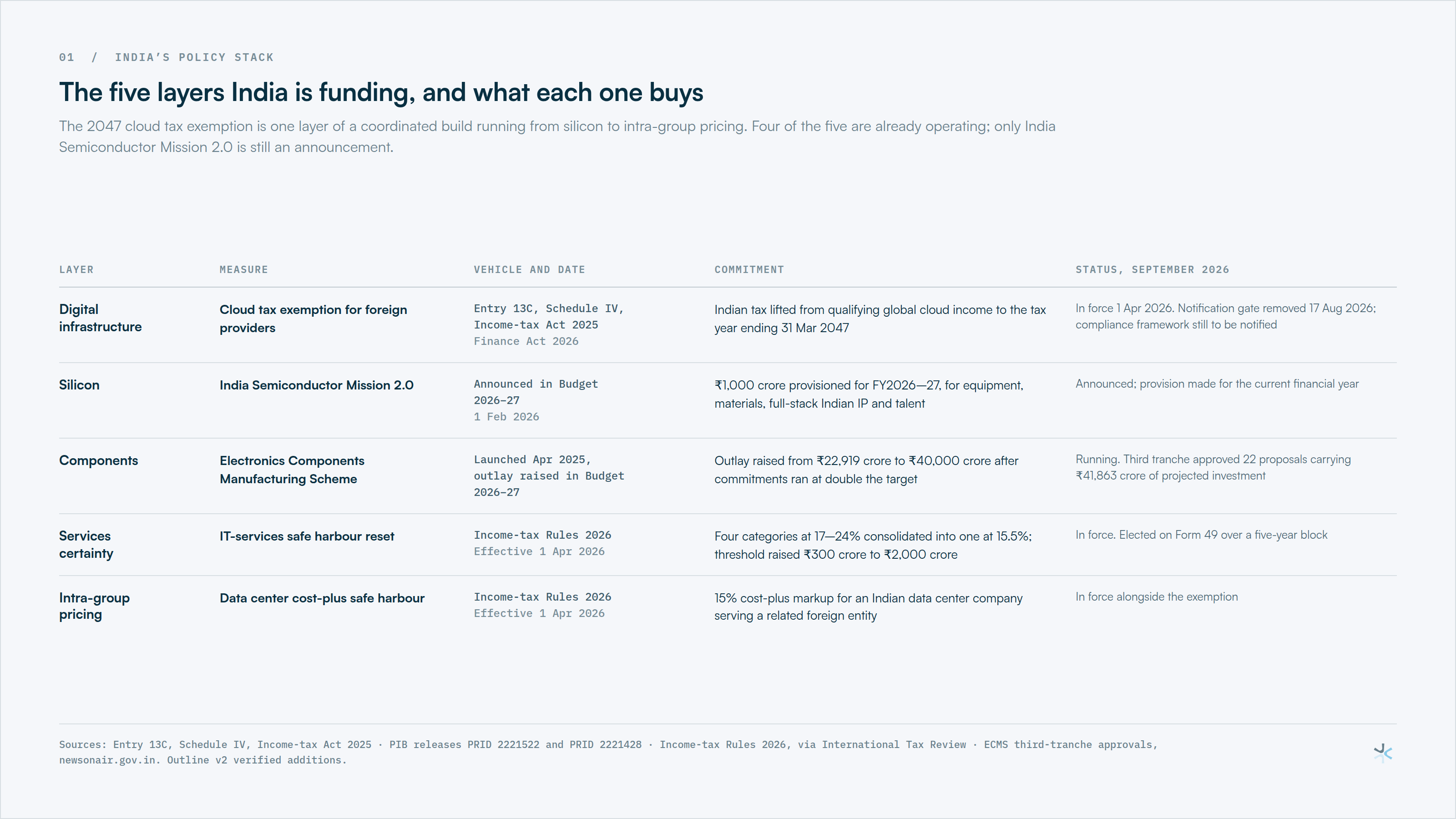
Read together, these are not five announcements but one architecture, and every measure in it substitutes a rule fixed in advance for a position argued afterwards. *International Tax Review* characterizes the direction as a move from dispute management to certainty design, which is a fair description of what a 21-year horizon, a fixed margin and a two-year agreement clock have in common.
A Rulebook That Corrected Itself in Ten Weeks
An architecture is only worth what its administration delivers, and here the first attempt did not deliver. Four cumulative conditions applied to the exemption as enacted. **Notification:** the foreign company had to be notified by the Central Government as a specified foreign company, and the facility had to be notified separately as a specified data center. **No ownership:** the foreign company could not own or operate any of the physical infrastructure of that facility, which itself had to be owned and operated by an Indian company. **An Indian reseller:** services sold to Indian customers had to run through an Indian reseller entity, keeping domestic transactions inside the Indian tax net. **Prescribed information:** the company had to maintain and furnish what the rules required.
The second condition has a consequence worth carrying forward. Because the benefit attaches to a foreign company that buys Indian capacity rather than one that builds it, the exemption is service-linked rather than asset-linked, and the Indian operator supplying that capacity stays fully taxable on its service income. Nasscom, the Indian technology industry's trade body, made exactly that point in arguing for the amendment, noting that the exemption benefits the foreign company while the Indian data center operator continues to be taxed.
The first condition is what stalled. Notification required a case-by-case administrative act that was never performed, and as of 4 August 2026 the count of notified facilities and notified companies stood at zero on both sides. The correction moved faster than the design had. An Income-tax (Amendment) Ordinance issued on 5 June 2026 was replaced by a Bill introduced on 4 August, passed by the Lok Sabha on 6 August and the Rajya Sabha on 10 August, and assented on 17 August. The Act removed both notification requirements outright and extended the definition to cover data centers leased and operated by an Indian company.
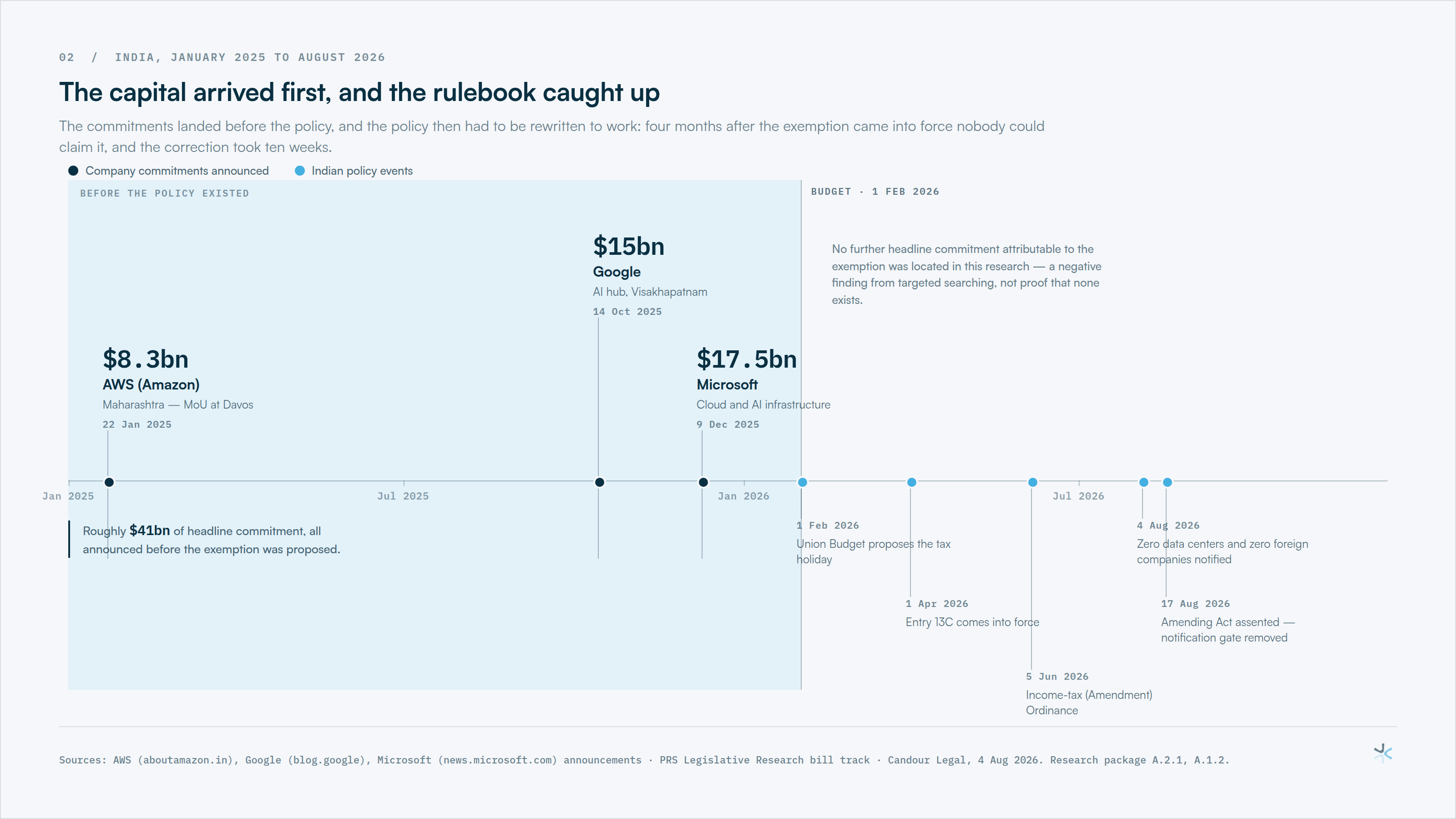
Both halves of that episode are the finding. A regime that cannot be used for four months of its first year is a real failure of design, and a legislature that diagnoses the failure and rewrites the statute inside ten weeks, by ordinance and then by Act, is demonstrating something most tax systems cannot. Which of those matters more to a company weighing a commitment against a twenty-one-year horizon is a judgment about how often the rules will need fixing again.
What Is Actually Being Built
Legislating capacity and having it are different things, so the next question is what physically exists. India's three headline commitments from the largest cloud providers all predate the Budget that is credited with attracting them. Amazon Web Services signed an $8.3 billion memorandum with Maharashtra at Davos on 22 January 2025. Google announced a $15 billion AI hub at Visakhapatnam on 14 October 2025, its largest investment in India. Microsoft committed $17.5 billion over four years on 9 December 2025, its largest investment anywhere in Asia.
Roughly $41 billion of headline commitment was therefore announced before the exemption was proposed, and the earliest of the three preceded it by more than a year. The policy cannot have caused what came before it, so the causation that fits the sequence runs the other way: capital was already committing at scale, that capital carried an unresolved and unquantified claim on global income, and India legislated the claim away. Vaishnaw's $200 billion is a ministerial forecast with no published basis, and it should be read against the $41 billion that was actually on the table before the forecast was made.
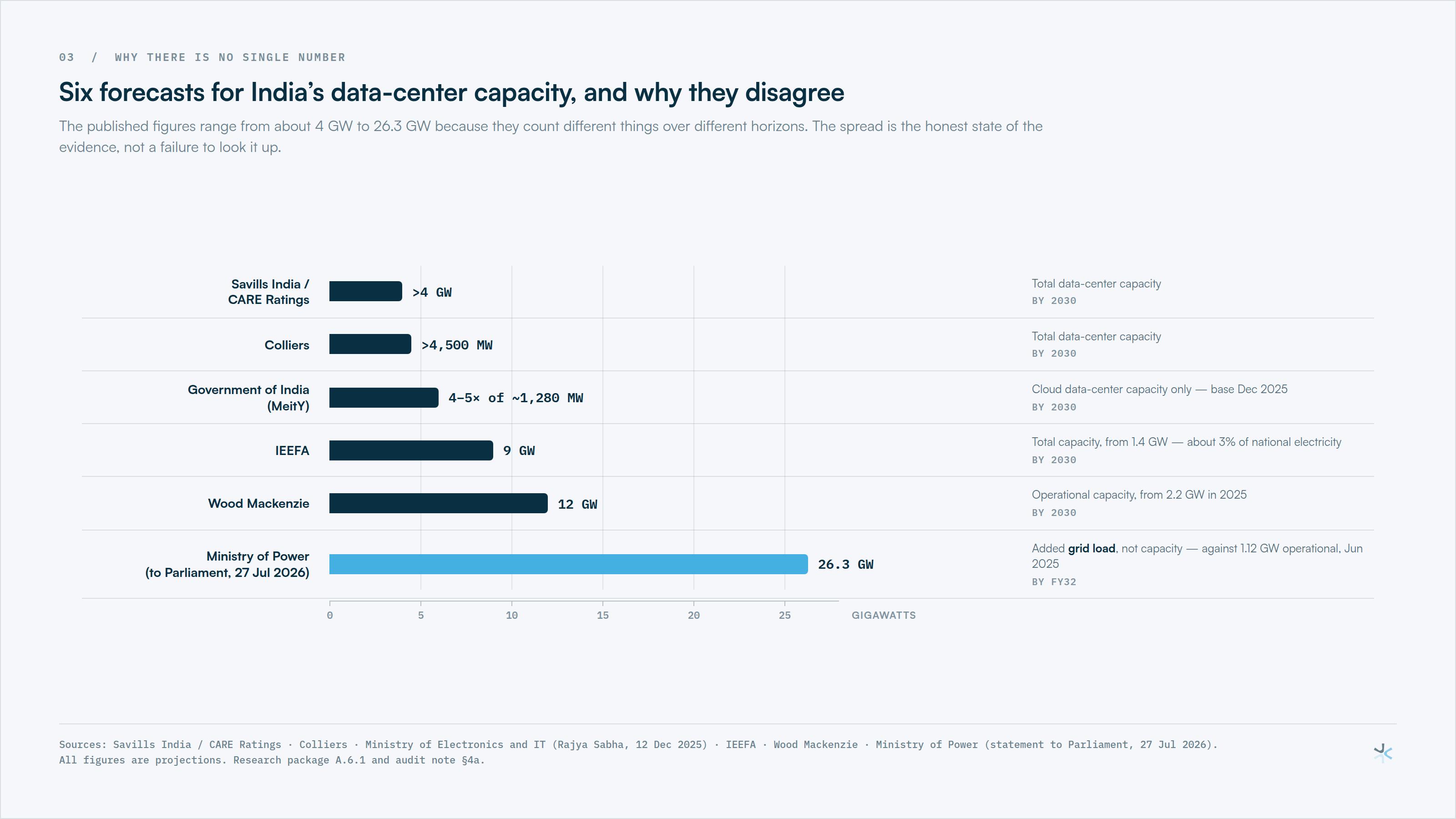
How large the build gets from here is genuinely unsettled, and the published figures cannot be reconciled into one number because they count different things. The Ministry of Electronics and Information Technology told the Rajya Sabha on 12 December 2025 that cloud data center capacity had reached about 1,280 megawatts and would grow four to five times by 2030. Wood Mackenzie, an energy research consultancy, puts operational capacity at 12 gigawatts by 2030, while the Ministry of Power told Parliament on 27 July 2026 that data centers may add 26.3 gigawatts of grid load by FY32, which measures something different again.
Ambition also has to be read against where this investment has actually been going. The fiftieth Global Investment Trends Monitor from UNCTAD, the United Nations Conference on Trade and Development, published on 20 January 2026, found that data centers took more than a fifth of global greenfield project value in 2025, with announced investment above $270 billion. The same report records that the investment concentrated in a handful of host countries led by France, the United States and the Republic of Korea, and that only a few emerging markets were among the top recipients. India is competing hard for a prize that has so far largely gone elsewhere.
What the Build Still Needs
Three things stand between the architecture and the capacity, and none of them is a tax question. The first is electricity. IEEFA, an energy finance research institute, projects Indian data center capacity rising to 9 gigawatts by 2030 and consuming about 3% of national electricity by then. That demand arrives on a grid which met roughly 80% of its annual transmission targets over five years and curtailed around 300 gigawatt-hours of renewable electricity in the first quarter of 2026 alone. Ashish Banerjee of Gartner, the technology research and advisory firm, put it plainly after the August amendment: tax certainty alone will not drive investments, and power availability, high-density grid connections, fiber connectivity and regional customer demand will keep deciding where capital lands.
The second is a live argument about who the policy is for. Yotta and ESDS Software Solution, both Indian data center operators, raised the disparity within days of the Budget, and Vaishnaw responded on 10 February 2026 that domestic and foreign investors would be treated at par. ESDS chairman Piyush Somani argued that the assurance settled nothing, since foreign hyperscalers could sit tax-free to 2047 while Indian firms paid full corporate tax on comparable operations. That assurance was described at the time as proposed rather than enacted, and the August amendment addressed notification and leasing rather than domestic parity.
The third is simply unfinished drafting. The compliance framework that would tell a company how to claim the exemption was still un-notified as of August 2026, and the Central Board of Direct Taxes, which administers India's income tax, was expected to issue its notifications only before the end of that year. Two questions remain open in practitioner commentary alongside it: S&R Associates, an Indian corporate law firm, flags that it is unclear whether the no-ownership test is breached by indirect ownership through an Indian subsidiary, and *International Tax Review* notes that the scope of the exemption is contested between an eligible company's whole income and only the income attributable to procuring and reselling data center services.
What This Asks of Anyone Buying Compute
For a buyer, the first question is whether any of this reaches the invoice, and the honest answer is that nothing located in this research shows a host country's corporate tax exemption passing through to customer pricing. The incidence points the other way: the exemption attaches to the foreign provider's income while the Indian operator and the Indian reseller both remain fully taxable, so the saving lands on a provider's income statement rather than in its price list. Regional price dispersion is real, and commercial cloud-pricing analyses put the spread between regions at 20% to 40% on identical architecture, but that dispersion is not shown to be tax-driven.
What moves capacity is better established, and it splits by facility type. Brookings, the public policy research institute, assembled roughly 1,500 United States data center facilities and 52 canceled projects against county employment records running from 2003 to 2024, and reports alongside that work a finding from the causal study it draws on: for hyperscale facilities, incentives represent about 2% of total construction investment, against about 62% for colocation. Subsidies move the marginal, cheaper facility, while power, grid interconnection and fiber move the gigawatt campus. Other governments are bidding with different currencies for the same thing, spending permitting time under Executive Order 14318, budget under Japan's METI subsidies, or sovereign balance sheet in the Gulf, where India is spending future revenue.
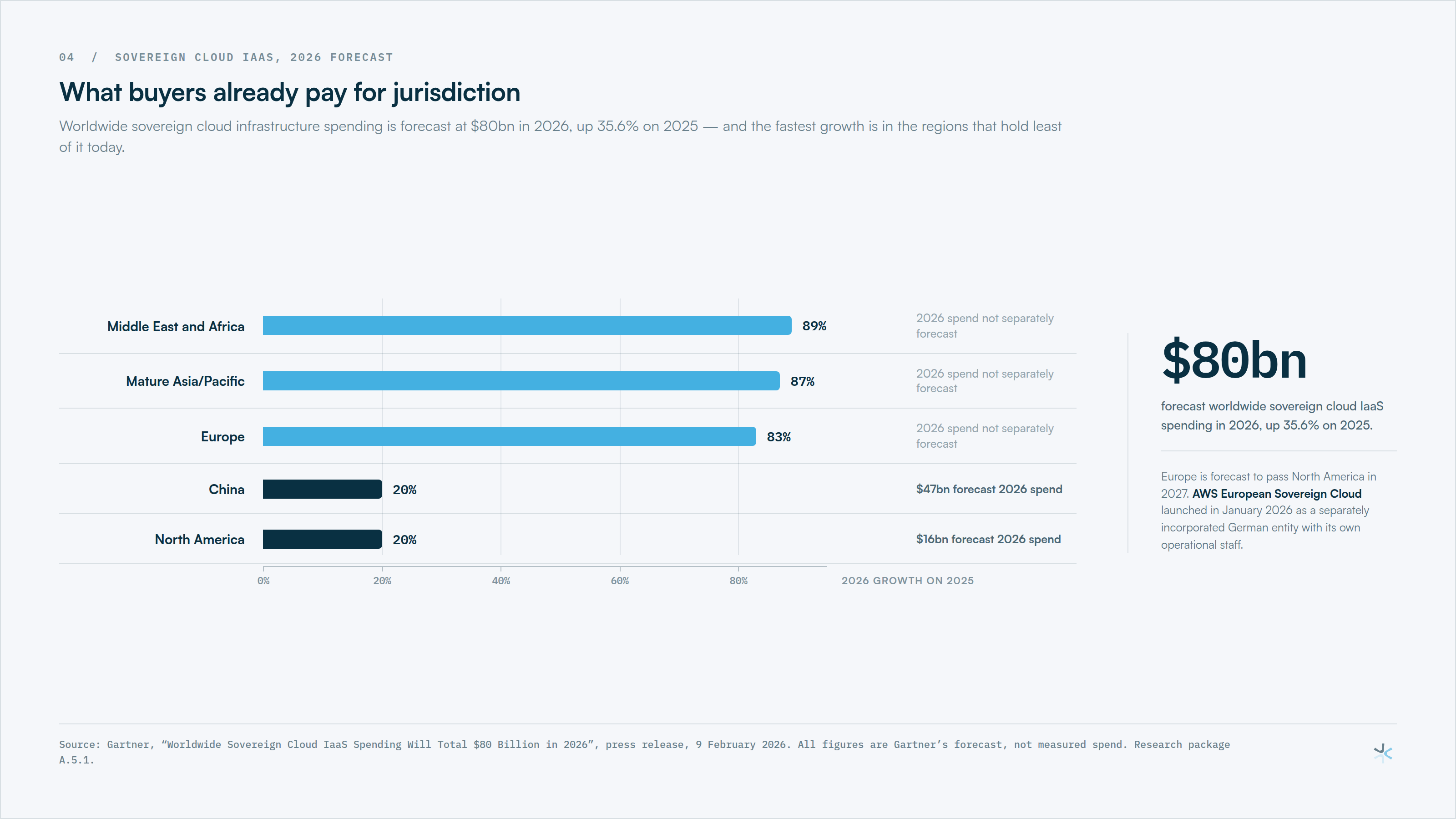
Jurisdiction is nonetheless becoming a first-order line item, and the reason has nothing to do with tax. Gartner forecasts worldwide sovereign cloud infrastructure spending at $80 billion in 2026, up 35.6% on 2025, with Europe expected to pass North America in 2027 and the fastest growth in the regions holding least of that capacity today. AWS incorporated a separate German entity for its European Sovereign Cloud in January 2026, with its own operational staff and its own legal perimeter, which is what a provider does when customers are buying legal control rather than compute.
The practical consequence is a change in what to ask a vendor. Not which government is offering the better deal, but whose legal certainty and physical capacity will still hold in year five of a contract signed today. On legal certainty, India's answer is materially stronger than it was eighteen months ago, and the direction of travel is the evidence rather than the promise. On physical capacity it is still open, and a buyer treating an Indian region as durable capacity today is pricing a grid build that has not happened yet.
Conclusion
India has spent this Budget cycle building the legal architecture for a compute economy, and the architecture is real. A 21-year exemption at Entry 13C sits above semiconductor and components programs with money already moving through them, above a transfer-pricing regime that consolidated four categories into one and raised its threshold nearly sevenfold, and above an advance-pricing program now clearing agreements on a published clock. When the first design of the exemption proved unusable, the state rewrote it by ordinance and then by statute inside ten weeks. Read against the permanent-establishment decisions it was written to neutralize, that is India making its jurisdiction safe to compute in, and it is a durable change rather than a headline.
What the evidence will not carry is that the architecture is the same thing as the capacity. All three headline commitments to India were announced before the exemption existed, the exemption was unusable for four months of its first year, the compliance framework was still unwritten in August, and the constraint that binds is a grid running behind its own transmission targets rather than a tax code that is now among the most generous in the world. India's compute decade is being built on foundations that are further along than most observers credit and on capacity that is further behind than the announcements suggest, and anyone deciding where to put a workload should price both.