Capping the Middleman, and the Insurer: Who Pays if IRDAI's Distribution Draft Survives Consultation
Introduction
On 23 September 2026 the Insurance Regulatory and Development Authority of India (IRDAI), the regulator of insurers and their intermediaries, released a consultation paper on commission caps and expense ceilings, titled "Recalibrating Economics of Insurance Distribution".
On 24 September PB Fintech, parent of the Policybazaar marketplace, closed about 36% lower at ₹1,207.20 on the National Stock Exchange, its biggest single-day fall. The platform Turtlemint hit its 20% lower circuit, while the general insurers ICICI Lombard and Go Digit closed 5.1% and 2.08% higher.
IRDAI's paper is a consultation, not a regulation: comments close on 25 October 2026, and it was not listed on IRDAI's exposure-drafts page, the usual next step toward binding rules. That gives corporate agents, lenders, broker platforms and insurers' finance chiefs about a month to work out who in their chain bears the cost and to tell the regulator.
An Expense Ceiling on Insurers, a Commission Cap on Distributors
The first day's split makes sense once the draft's two levers are separated, since each binds a different party. The first is the expenses of management (EoM) ceiling, which caps an insurer's operating expenses plus commissions as a share of premium. The 2024 regulations set it at 30% of gross written premium (GWP) for general insurers and 35% for standalone health insurers, with a product-by-product allowance for life insurers. GWP includes reinsurance accepted from other insurers, so the draft would measure general insurers on gross direct premium income (GDPI), removing what IRDAI calls "the anomaly of double counting", while life EoM would become total expenses over total premium.
Confusing the levers produced an Asia Insurance Post headline that "Commission on general insurance products to be slashed from 30% to 20%", when that path belongs to the general insurer's EoM ceiling in IRDAI's press release, not to any distributor's pay.
The second lever, the commission cap, limits what a distributor may receive on a product. IRDAI distinguishes base commission from total payouts, which add rewards and incentives, and its data shows rewards adding 30–60% on top of base commission in life corporate agency. Because the draft would fold every payment "by any name whatsoever" into commission, its caps are all-inclusive and the reward layer loses its route around them.
Insurance Distribution Entities (IDEs), the draft's name for open-architecture sellers such as banks, non-bank finance companies (NBFCs), brokers and web aggregators, may sell several insurers' products, and banks may today tie up with up to nine insurers each in life, general and health. Agents and associates are closed architecture, selling for one insurer per segment, while a bank acting for one insurer is a single tie-up bank and one acting for several is a multi tie-up bank.
From Board-Approved Flexibility Back to Hard Caps: What the Draft Would Change
Under the 2016 regulations, according to Monika Halan's 2017 commentary, life first-year commission was capped at 40% for pure risk and 35% for bundled products. From 1 April 2023 IRDAI did away with product-wise limits and let board-approved policies set pay inside one EoM ceiling, which the draft keeps while reinstating hard caps within it, on the ground that "Board approval has often been a formality rather than being substantive". Its proposed 20% and 25% first-year caps on life policies paid over ten years or more sit below the 2016 levels too, so the draft would go tighter than the old regime rather than return to it.
EoM of 15% Then 12.5% for Life, 25% Then 20% for General, With FY2027-28 as Year 1
Box 2 proposes for life insurers "EoM of 15% of the premium in 2 years and 12.5% in 5 years (FY2027-28 being Year 1)", and 10% within five years for those already below 15% in FY25. General insurers would reach 25% in two years and 20% in five of domestic GDPI, a two-year step the press release omits. FY2027-28 is Year 1 for this glide path alone, and the paper gives no start date for the commission caps.
An insurer that missed the path would face "restrictions on new product launches, restrictions on dividend distribution" and, in extreme cases, on new business through the channel responsible. Its question 15, "Does the sector need a longer timeframe to achieve the proposed norms?", leaves the pace itself open to comment.
Credit Life From 22% to 2%: Caps Below Today's Average Commission on Every High-Commission Line
The commission lever is finer-grained, and for regular-premium life policies it steps with the premium payment term (PPT), the years over which premium is paid, from a 5% first-year cap for IDEs below five years to 20% at ten years or more. The draft's design principles set lower caps for open architecture than for tied selling, "nil or very low" rates on mandatory and loan-packaged cover, and lower rates on single-premium products. Pay to point-of-sales persons (PoSPs), individuals selling under a distribution entity, would come out of that entity's commission.
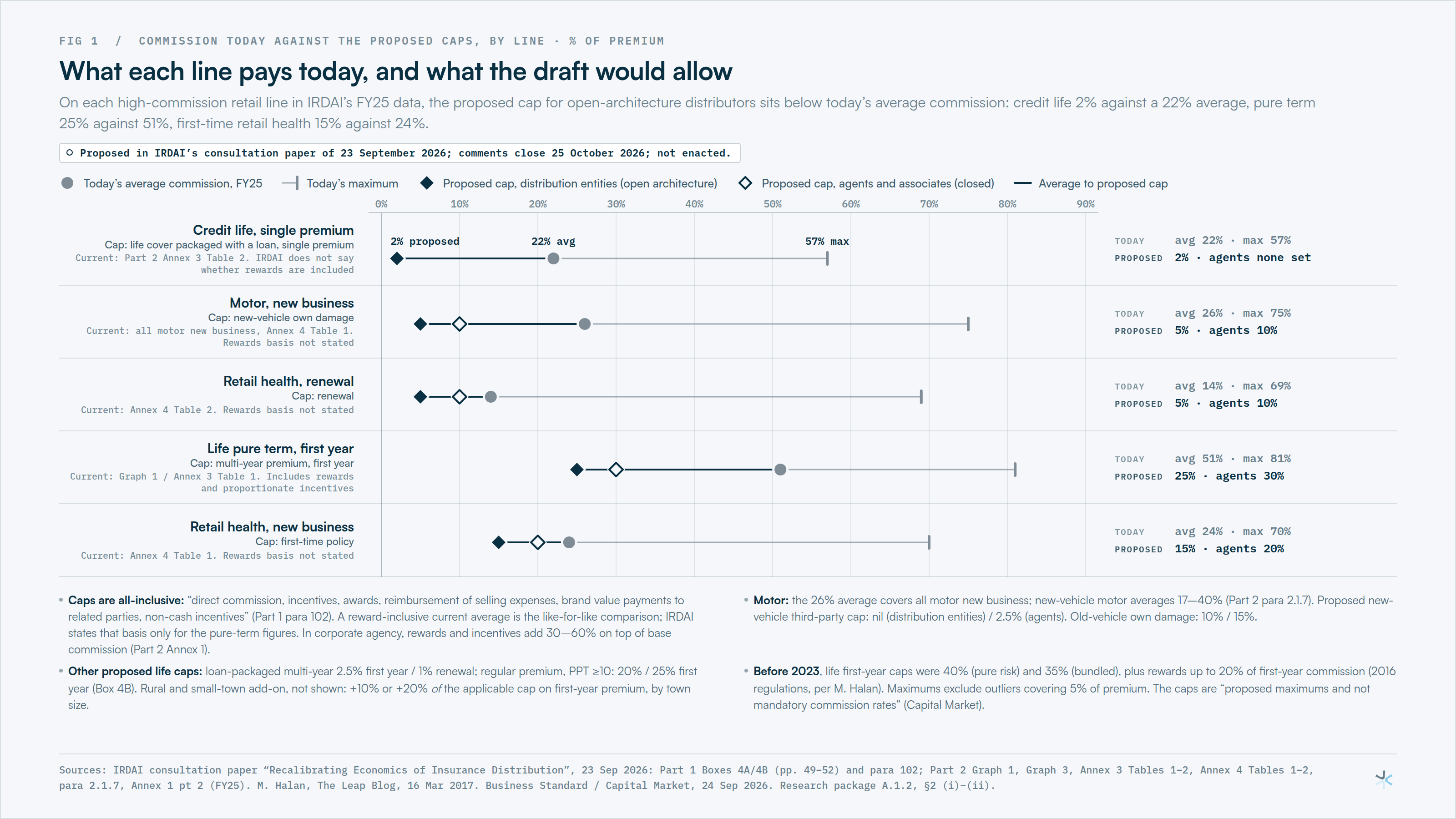
Business Standard's Capital Market desk noted that these are "proposed maximums and not mandatory commission rates", yet they would bind in practice, because IRDAI's FY25 averages sit above the proposed cap on every line in Fig 1. The steepest gap is on credit life, where a 22% average single-premium commission would meet a 2% cap once the cover is packaged with a loan. Pure term, whose 51% average is the only one in Fig 1 that IRDAI states includes rewards, would face a 25% cap for IDEs.
Corporate-Agent Pay Up 125% on Premium Up 28%: IRDAI's Case and Its Limits
IRDAI grounds its case in its own data, a party's evidence for its own proposal. From FY23 to FY25 total remuneration paid to a sample of life corporate agents, covering about 92% of their premium, rose 125% against new-business premium growth of 28%. Persistency at the 61st month, the share of life policies still in force after five years, was 48% against 71% for policies bought online, a gap that may partly reflect who buys online and that no source has tested.
The counter-case comes mostly from sellers. An unnamed senior broker told Asia Insurance Post the draft would be "a death knell for the brokers particularly small and medium size players". Indraneel Chatterjee, chief operating officer of the platform InsuranceDekho, argued that cost cuts belong "alongside the larger goal of expanding insurance penetration", a goal IRDAI itself sets as Insurance for All by 2047. IRDAI replies that incentives buy churn rather than coverage, with individual life policy counts "broadly stagnant over the last decade", and with no published volume-loss estimate, the penetration objection stays plausible but unquantified.
Did the 2023 Flexibility Cause It? Reclassification, a Flat Industry Ratio and the GST Credit Loss
IRDAI says the 2023 flexibility "was largely channelled into higher distributor pay-outs", a finding it states for general insurers, and its Box 1 shows private life insurers' total expense ratio rising from 16.5% in FY21 to 20.2% in FY26. Three pieces of evidence complicate that attribution.
**Reclassification:** IRDAI concedes that insurers "reclassified distribution related payouts under the commission classification" after booking them as operating expenses, so part of the rise in reported commission is relabeling rather than new spending.
**A flat industry ratio:** across all life insurers, total expense to total premium was 15% in FY21 and 16% in FY26, against private insurers' rise over the same years, which concentrates the rise in private insurers.
**The GST credit loss:** individual life and health policies became GST-exempt from 22 September 2025, costing insurers input tax credit on commissions and other expenses, a loss BusinessToday estimated could raise operating costs 5–7%. HDFC Life said its FY26 new-business margin would have been flat excluding GST and surrender regulations.
No study isolates the 2023 effect, so that causal claim remains IRDAI's position.
Twenty of 22 Life Insurers Already Above 15%: The Draft Caps Insurers Too
Part 2 of the paper shows where individual insurers stand, in anonymized tables of those in business for at least five years.
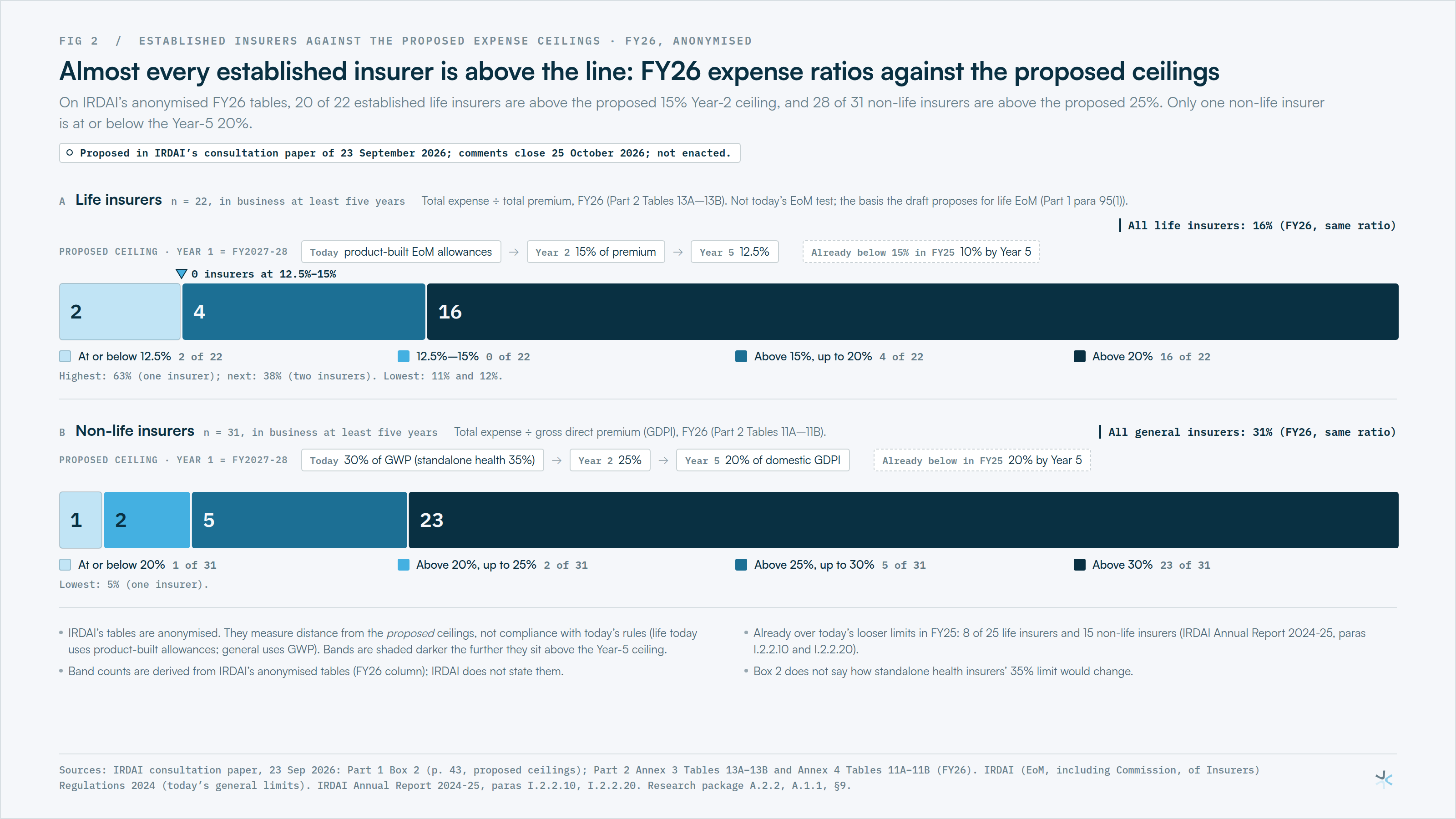
On the FY26 tables, 20 of 22 life insurers sit above 15% on total expense to total premium, the basis the draft proposes for life EoM rather than today's product-built test, and 28 of 31 non-life insurers sit above 25% of GDPI, so nearly all would have to cut total expenses. The counts measure distance from proposed ceilings rather than compliance, yet IRDAI's 2024-25 annual report records 8 of 25 life and 15 non-life insurers already over today's looser limits in FY25.
In late August 2026, according to the policy site PolicyCircle, IRDAI barred four insurers from opening new offices over those breaches, among them ACKO General, whose EoM exceeded its allowance by ₹334.78 crore, so the expense ceiling binds insurers before any cap reaches a middleman.
SBI Life at 10.6%, Most Others Well Above: Which Life Insurers Can Absorb the Glide Path
SBI Life disclosed an FY26 total cost ratio of 10.6%, with bancassurance at 60% of annualized premium equivalent, against a cost-to-premium ratio of 18.2% at ICICI Prudential Life. Value of new business (VNB) margin, a company-reported measure of new-business profitability, ran from 24.2% at HDFC Life to 27.5% at SBI Life.
Channel structure is consistent with the spread: in IRDAI's anonymized data the largest private life insurer paid its single tie-up promoter bank 8% of first-year premium, while the second-largest paid its multi tie-up promoter bank 42%. The market's ranking matches: the brokerage Emkay called SBI Life and the state-owned LIC "relatively better placed", while the bank HSBC, as Inc42 reported, described the EoM limits as stringent and named HDFC Life and Max Financial as more affected. VNB margins leave profit to absorb some of the hit, but no house estimate of the VNB impact was found, so cutting multi tie-up payouts, shifting to agency and direct sales and lobbying for a longer path remain scenarios.
General Insurers: A Tighter Ceiling, but Relief From a Motor Commission Race
General insurers face the tighter ceiling, since the sector's total expenses ran at 31% of GDPI in FY26 against the proposed 25% step in Fig 2. Yet the caps could end a race in which motor commission through brokers rose from 9% to 25% in two years, and Jefferies, the investment bank, argued that "lower commissions may reduce competition in motor insurance, benefitting ICICIGI/Go Digit". Both closed higher on 24 September, despite a BusinessToday snapshot of unstated time showing ICICI Lombard down 2.33%.
Banks and NBFCs: A Fee Pool Built on the Products the Draft Cuts Hardest
On the bank's side, promoter-bank payouts are a fee line, and banks placed about ₹68,000 crore of the ₹80,000 crore of sampled corporate-agency life new-business premium in FY25.
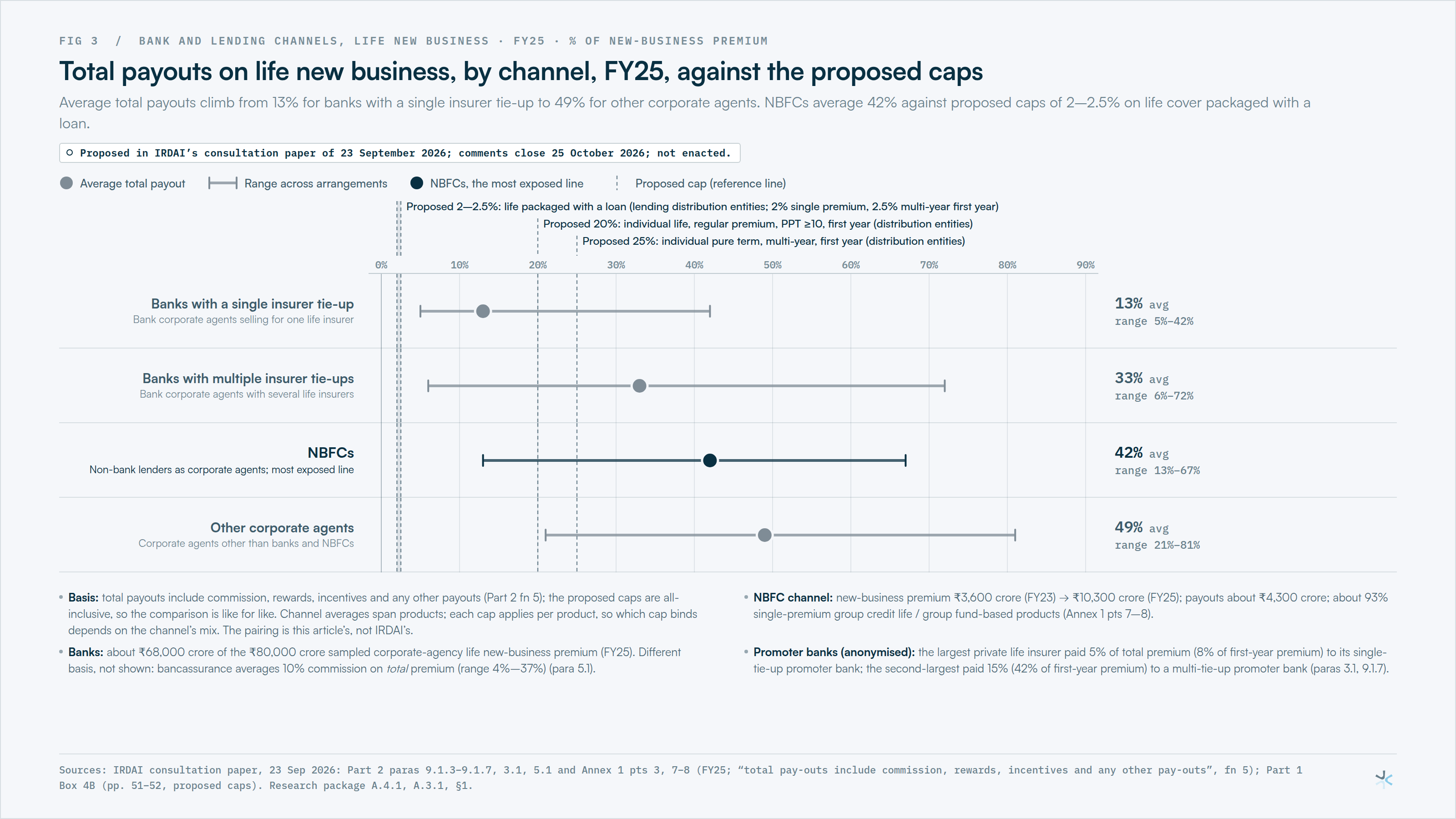
In Fig 3's ladder the NBFC line, at a 42% average total payout, is the most exposed because of what it sells. NBFC new-business premium grew from ₹3,600 crore in FY23 to ₹10,300 crore in FY25, and about 93% of it was single-premium group credit life or group fund-based business, facing proposed caps of 2% (loan-packaged single-premium term) and 0.5% of contributions (group fund-based).
The Conduct Rules, and the Part RBI Has Already Fixed for 1 January 2027
The draft's conduct rules would "prohibit any volume linked or reward linked incentive for bank or NBFC staff selling insurance", ban compulsory bundling with loans, tag each policy to its seller with commission clawback, and let IDEs work with any number of insurers.
Part of this is already fixed, because the Reserve Bank of India (RBI), the banking regulator, issued final directions on 15 June 2026, effective 1 January 2027, that bar commercial-bank staff from incentives paid by third-party product providers and prohibit compulsory bundling. RBI issued parallel final directions to NBFCs the same day, also effective 1 January 2027, with the same staff-incentive and bundling bans. IRDAI presents its rules as complementing RBI's, so for banks and NBFCs the IRDAI-specific increment is the rate caps, disclosure and clawback.
From 0.6% to 71% of Profit: Why the Houses' Bank Estimates Do Not Compare
The one disclosed figure anchors a disputed number: HDFC Bank reported FY26 bancassurance fees of ₹5,687.53 crore from life and ₹1,239.69 crore from general and health insurance. Other estimates come from analysts, each on its own metric.
Citi said the draft could compress bank and NBFC distribution economics by 70–90% in several high-margin categories, while Axis Securities called it "a commission-rate reset rather than a volume issue". Jefferies put bancassurance at 7% (HDFC Bank) to 18% (IndusInd Bank) of FY27 normalized profit before tax, whereas JM Financial put insurance fees at 0.6% of ICICI Bank's profit before tax and 14–71% for small finance banks. The houses agree only on the order, with the largest banks least exposed relative to profit and mid-size banks, small finance banks and credit-heavy NBFCs most exposed.
Platforms and Dealers: Why PB Fintech Lost About 36% in a Day
IRDAI's data on brokers explains the first day's steepest fall. From FY23 to FY25 broker commission including rewards rose from ₹6,348 crore to ₹17,348 crore, and retail business supplied 54% of broker premium but 78% of commission.
PB Fintech's May 2026 filing says "70%+ Core Online Insurance Revenue comes from Protection (Health & Term)", with ₹935 crore of FY26 renewal revenue at about 80% margins. A 5% IDE cap on health renewals, with PoSP pay drawn from the principal's commission, would cut its take rate, the share of placed premium kept as revenue, where it earns most. Jefferies estimated that ["a 10 per cent cut in new business commission rates translate[s] to a 10-12 per cent fall in their earnings"](https://www.businesstoday.in/markets/stocks/story/pb-fintech-shares-crash-30-why-policybazaar-parent-fell-like-deck-of-cards-1-42-lakh-retail-investors-hit-targets-557514-2026-09-24) for PB Fintech and Turtlemint, and the research firm Bernstein called PB Fintech "the most impacted company".
Their responses are scenarios: long-term life, customer-paid fees (IRDAI's question 18 asks if the sector is ready) or in-house underwriting, which chairman Yashish Dahiya raised before this draft, when, as Inc42 reported, he warned that hard caps could pose an existential threat to distributors.
Motor dealers carry an unlisted version of the same exposure, as vehicle makers' brokers and dealers hold about 30% of motor premium at a 24% average commission. The draft would make them register as IDEs or PoSPs and display the option of a Market Infrastructure Institution (MII), an insurer-promoted platform such as Bima Sugam, and no estimate of the effect was found.
The Customer's Share Is Asserted, Not Mandated
IRDAI says the EoM cut "is intended to lower the overall cost of insurance". Yet by IRDAI's own data, "policyholders generally pay the same premium irrespective of the distribution channel", so a cost cut that is not repriced lands first on the insurer's expense line. The draft sets no pass-through rule and only expects lower prices on MII platforms.
IRDAI's hoped-for gain is fewer mis-sold policies, and surrenders took ₹2.33 lakh crore, or 37% of life benefits paid in FY25. The access cost runs the other way: Chatterjee calculates that a 5% cap on an ₹800 two-wheeler own-damage premium leaves about ₹40, which IRDAI answers with a small-town and rural add-on worth 10% or 20% of the applicable cap. Neither the gain nor the access cost has been quantified.
What Australia's LIF and the UK's RDR Measured After Commission Reform
The only measured evidence comes from abroad. Australia's Life Insurance Framework (LIF) stepped upfront commission caps down to 60% by 2020, and the Treasury's review found "a 34 per cent proportionate decrease" in the first-year commission rate, with advice-file pass rates rising from 37% to 58%. New policies fell, average premiums rose about 15% and advised clients grew older and wealthier, and the review warned that "it is difficult to conclude that the improvement was because of the LIF reforms".
The UK's Retail Distribution Review, which banned investment-advice commission from the end of 2012, cut product bias, but adviser charges "appear not to have decreased", according to the Financial Conduct Authority, the UK regulator. With Australia's caps far above India's and neither market sharing India's credit-life structure, these precedents support a projection of less churn and thinner low-end access, not of lower premiums.
A Ranked Bill, Not a Single Payer: Who Has the Least Room Before 25 October
Here, Table 1 ranks each party's room to absorb the draft and grades its evidence.
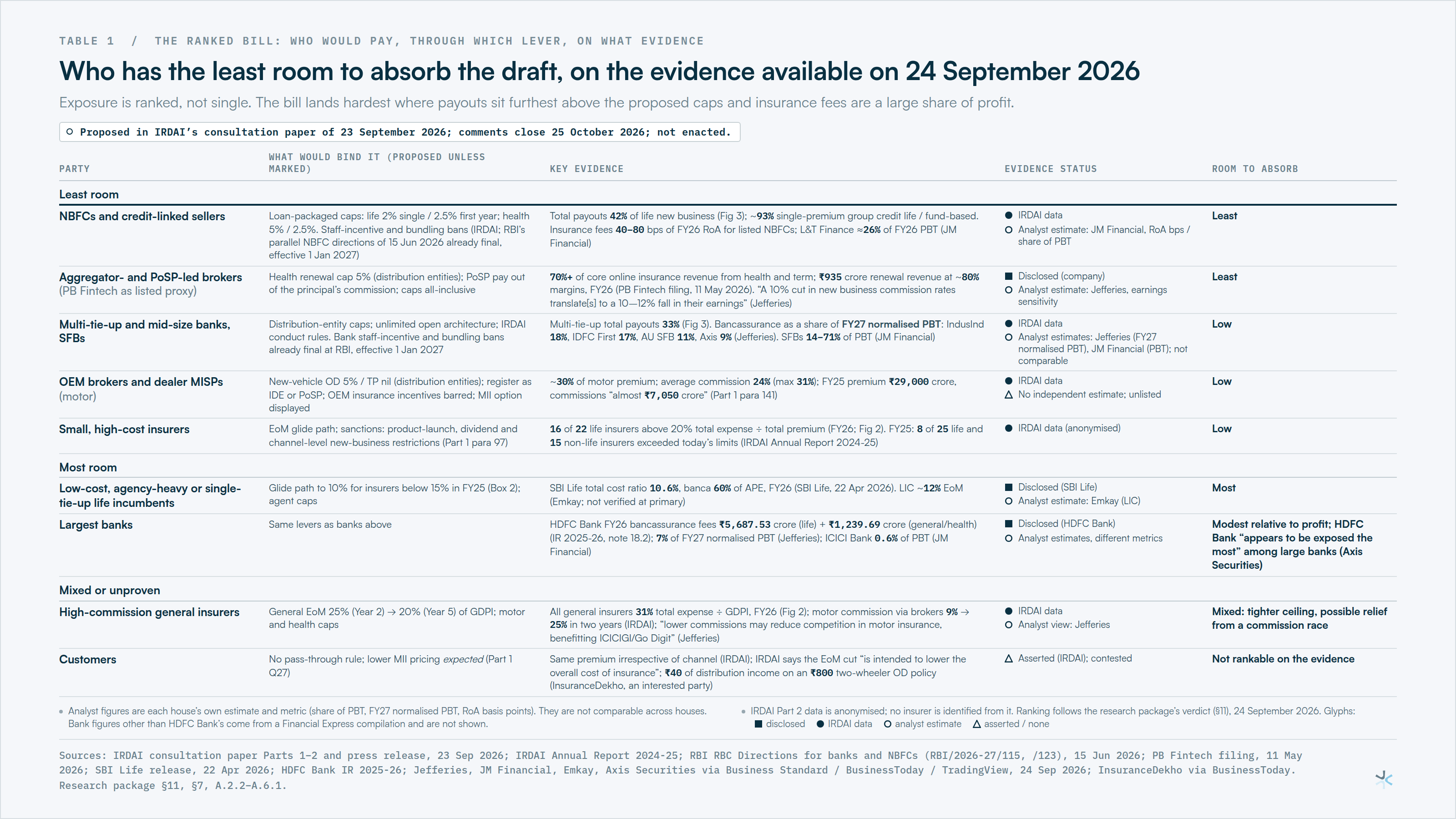
Exposure is highest where payouts sit furthest above the proposed caps and insurance income is a large share of profit, two conditions that meet in credit-linked NBFC business and retail platforms. The market priced the same order on 24 September, with distributors falling hardest, HDFC Life, Max Financial and ICICI Prudential Life down 4–10%, SBI Life and LIC barely moved and two general insurers up, although an unverified broader market fall clouds the smaller moves.
The paper also leaves room to argue: it gives no date for the commission caps, does not say how standalone health insurers' 35% ceiling would move, and any regulation would need its own exposure draft.
Conclusion
If adopted as drafted, IRDAI's paper would reallocate distribution economics rather than trim them, through an EoM path that 20 of 22 established life insurers sit above and caps below today's average commission on every high-commission line. The middleman is only half the payer, since the draft caps insurers too. The bill is ranked: credit-linked NBFCs, retail platforms, multi tie-up and mid-size banks, dealers and small high-cost insurers have the least room, low-cost captive incumbents and the largest banks the most, and some high-commission general insurers may gain.
The evidence will not carry three further claims. It does not show that customers would pay less, because IRDAI asserts the gain without mandating pass-through and Australia's record is mixed. It does not make the conduct hit wholly IRDAI's, because RBI's directions bind banks and NBFCs from 1 January 2027 regardless. Nor does it settle the size of the bank and NBFC hit, on which the houses differ by metric, so until comments close on 25 October 2026 every party's response remains a scenario.